- Solutions
- Pricing
.avif)
There’s a number retail leaders don’t like to talk about publicly, because it exposes everything that’s broken in their customer experience.
Brands with strong omnichannel engagement retain 89% of their customers. Brands without it retain only 33%.
That 56-point gap is the entire story.
It explains shrinking margins, rising acquisition costs, loyalty programs that don’t really build loyalty, and why retailers keep talking about personalization but rarely deliver it consistently.
Shoppers expect relevance. Not more messages but better messages. Not random discounts but timely nudges. Not generic product lists but matched recommendations.
And this expectation exists across web, mobile, email, and the store floor. Retailers know this, but knowing doesn’t fix the problem.
Because the real issue isn’t “lack of CRM.”
Almost every retailer has a CRM tool. The problem is:
This blog breaks that cycle. If you want to understand how crm in retail industry actually creates revenue, what modern personalization looks like (not the buzzword version), the pitfalls that quietly kill projects, and where a no-code platform like CodeBlox fits without disrupting your existing stack, you will find all of it here.
A real customer relationship management in retail industry setup should feel like a live engine:
Retailers usually have the data, the channels, and the intent, but not the unifying layer that turns it all into something intelligent.
A proper retail crm system changes that by becoming a connective hub.
.png)
CRM isn’t new. What is new is the pressure to drive retention without inflating budgets. Three forces are pushing retailers back toward CRM, but with sharper goals:
Acquisition costs are up. Competition is up. Retention, on the other hand, compounds.
Market reports consistently show multi-year growth in CRM and retail engagement technologies, as brands finally understand what they want from these systems: accuracy, speed, and automation.
Retailers have stopped debating “should we personalize” and started debating “why doesn’t our personalization actually work?”
Good personalization = higher AOV, improved repeat purchase, better margin protection, and more brand stickiness.
{CTA button:Explore the CodeBlox:https://www.codeblox.com/solutions/no-code:See how CodeBlox actually builds retail CRM workflows that work.}
Retailers love strategies. But strategies fail without the technical backbone to support them. Here’s the simplified, real-world view:
POS sends signals. E-commerce sends signals. Returns, loyalty, app behavior, service logs, everything sends signals.
If these signals aren’t landing in the same place quickly, your CRM becomes outdated before it even triggers anything.
If your CRM thinks the same shopper is three different people because they browse online, log out, purchase offline with a phone number, and redeem loyalty through the app, you will never have the right data. Identity resolution links behavior in a privacy-respecting way so the experience always feels coherent.
Include rule-based workflows, simple but reliable, and machine-learning recommendations, dynamic and personalized.
Industry research repeatedly points out that decisioning is where retail leaders create the real competitive edge.
This is where speed matters. A customer who abandons a cart should get an email or notification in minutes, not tomorrow afternoon. Same with replenishment reminders, VIP alerts, and personalized offers.
Let’s skip the generic marketing examples. Here’s what truly effective retail personalization looks like:
Customer bought skincare 30 days ago? Trigger reminder. But only if it’s available at the nearest store (inventory-aware personalization is underrated and extremely effective).
Store associates see exactly what the customer looked at online, plus size, color preferences, past purchases, loyalty tier, wishlist items. Clienteling done right increases store conversions. Consistently.
Homepage shifts subtly based on browsing patterns and purchase frequency. Category pages are reordered based on what similar customers engage with. You don’t force personalization but you guide it.
If it’s raining in Mumbai, send offers for boots. If a new collection hits the Delhi store first, alert nearby customers.
High-value customers should never receive the same experience as one-time shoppers.
VIPs get:
This segment drives most of the ROI from personalization.
Customer abandons an item? Don’t just send a reminder, but send three alternates based on:
This is algorithmic personalization, not guesswork.
CRM for retail industry fails usually because of technology. They happen because of execution cracks that nobody addresses early enough. Here are the real pitfalls:
POS, loyalty, and e-commerce run differently → customer record is messy. When identity is messy, personalization becomes random.
If your CRM relies on batch syncing, you’ll always be late. Real-time matters a lot more than retailers admit.
IT gives you a six-month timeline. Marketing needed the automation last quarter. By the time the flow goes live, behavior patterns have changed.
If associates hate the CRM UI, they won’t use it. If they won’t use it, the brand loses its biggest personalization channel.
Recommending out-of-stock items kills trust instantly.
Agencies build flows you can’t maintain without them. Retailers get locked out of their own automation.
You avoid all of these by choosing tools that are flexible, easy to iterate on, and designed for omnichannel retail.
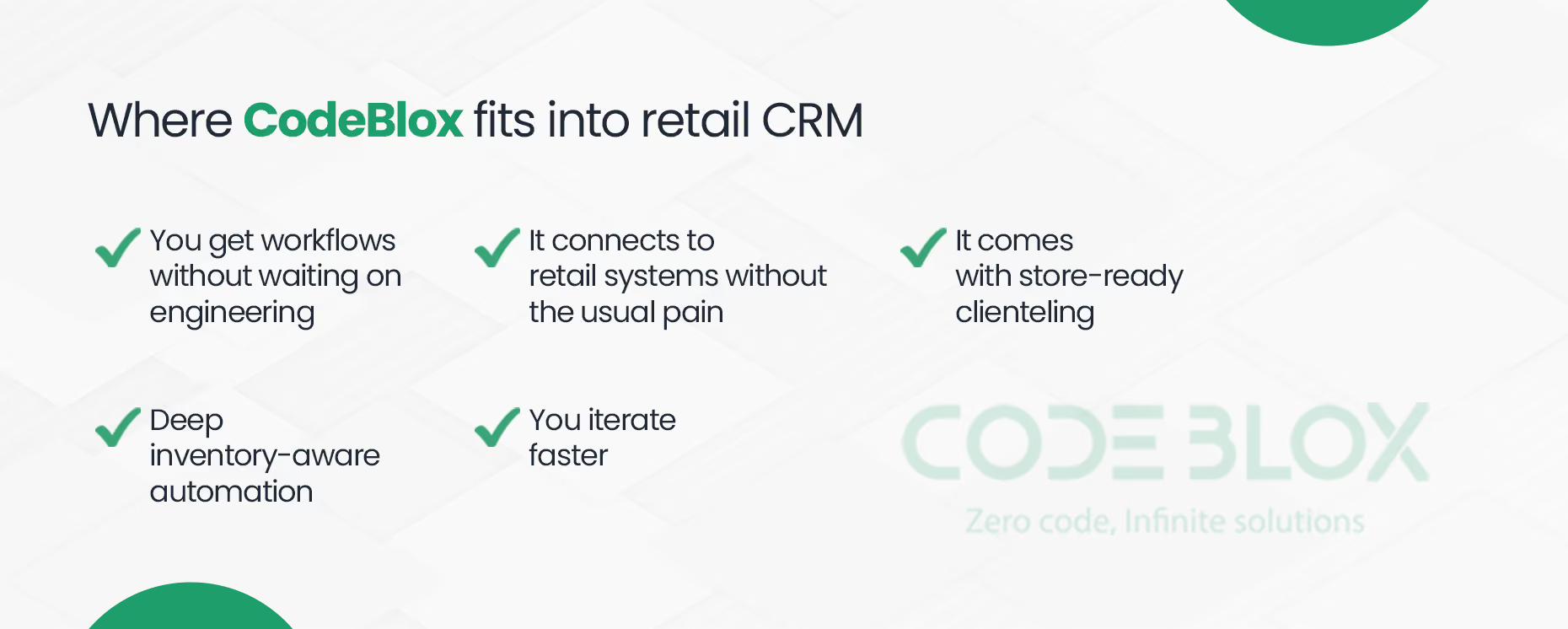
CodeBlox doesn’t try to be the whole CRM. It becomes the part that finally makes CRM usable. The execution layer that unifies data, automates decisions, and activates personalization across channels.
Retailers adopt CodeBlox because it solves the three hardest parts of CRM:
Marketing wants a replenishment flow?
Build it visually.
Add conditions.
Check inventory.
Hit save.
It’s live.
POS → E-comm → Loyalty → Email/SMS → Inventory
You connect, map fields, test, and move.
Associates get a clean UI.
They see:
Finally, the store floor becomes part of your personalization engine, not detached from it.
CodeBlox makes it easy to add:
These are the kinds of workflows that lift conversions dramatically.
You build, test, delete, tweak, without any dependency on developers.
This entire automation takes minutes, not weeks:
This is the kind of modern retail experience customers respond to.
Most retailers overcomplicate CRM rollouts. Here’s a practical path:
This keeps the project lean, fast, and outcome-focused.
CRM software for retail industry is a revenue function.
The retailers winning today aren’t the ones with the biggest systems, but they are the ones who execute personalization faster, cleaner, and with more context. They unify customer data, make smarter decisions, and activate those decisions across every touchpoint without depending on heavy engineering cycles.
{CTA button:Explore CodeBlox:https://www.codeblox.com/solutions/no-code:Take a closer look at CodeBlox in action. We will show you how teams build retail workflows and unify customer journeys using visual automation.}
Find answers to the most common questions about our no-code platform and how it can help you build powerful business application solutions without writing a single line of code.
%20(1).avif)
Tilly leads Operations and Solution Delivery at CodeBlox, partnering with enterprise teams to design scalable business systems before development begins. With hands-on experience across ERP, CRM, finance automation, and industry-specific digital transformation projects, she writes about solution architecture, process optimization, AI-powered workflows, and the practical decisions that determine whether enterprise software succeeds in the real world.
.avif)
%20(1).avif)

%20(1).avif)

.avif)
.avif)
.avif)
.avif)

.avif)
.avif)
.avif)


.avif)
.avif)
.avif)
.avif)
.avif)
.avif)
.avif)
.avif)
.avif)
%20(1).avif)

.avif)


.avif)
.avif)
.avif)
.avif)

.avif)
.avif)
.avif)

%20(1).avif)
.avif)