- Solutions
- Pricing
Real estate moves fast, but most agents' systems don't. Between Zillow inquiries, open house signups, referrals, and social DMs, leads arrive from everywhere. And keeping track of them in a spreadsheet or a handful of sticky notes is a losing game. The pipeline gets messy and follow-ups slip. Someone submits a listing inquiry on Saturday, you get to it Monday, and they have already signed with another agent.
This is not a hypothetical. The average lead response time across the industry sits at 47 hours, and only 27% of leads ever get contacted at all. Meanwhile, agents who respond to web leads within 5 minutes are 21 times more likely to qualify that lead compared to those who wait 30 minutes. The gap between knowing this and actually doing it consistently is a systems problem
And that’s where a no-code CRM for real estate gets you to that point, especially for teams looking for a practical CRM for real estate agents without long setup cycles or heavy costs.
Real estate pipelines usually break in the same ways. Leads come in from different places like listing sites, referrals, social media ads, and open houses, and not all of them are serious. Someone casually filling a form late at night gets mixed with a buyer who wants to close in 30 days. As a result, both get the same follow-up, and the serious buyer often ends up waiting longer.
Then there is the everyday mess. Agents keep going back to long email threads before calls, teammates keep asking each other for updates, and important notes are hard to find when needed. Because of this, over 75% of businesses report a significant reduction in time spent on manual tasks after implementing a CRM, and in real estate, that saved time really matters over a busy few months.
Compliance is something most agents ignore until it becomes a problem. Client data stored in shared spreadsheets without proper control is risky. There is no clarity on who accessed or changed what, and rules around data privacy are getting stricter. That’s why a proper real estate CRM keeps everything organized, secure, and easy to track as deals move ahead.
Almost no traditional CRM platforms are built with making real estate management easy in mind. They take months to configure properly, cost a lot to customize, and still end up feeling like a square peg for a round hole when you are juggling active listings, buyer timelines, showings, and compliance paperwork simultaneously.
However, no-code takes a different approach entirely.
Those solutions let you reshape your process around your operations. So, instead of buying a ready-made tool, you get the flexibility to build a workflow that mirrors how your team functions, your personalized stages, your lead sources, and your follow-up rules.
Gartner projected that 70% of new applications are being built on low-code or no-code platforms by 2025. And these platforms can make software development as much as 10 times faster, which means your CRM can be functional within just a few days!
At its core, your CRM should keep every contact, stage update, and conversation in one place, and do something useful when things change without you having to remember to act. AI features like draft follow-ups, smart tagging, and note clean up are worth adding eventually, but they only perform well once the underlying data is tidy. Layering them on before that just creates more mess to manage.
CodeBlox is built with this workflow in mind, so real estate teams can set up lead intake, pipeline stages, and automations without needing a developer at every turn. If you want to know what separates a capable platform from a basic one, start with this breakdown of no-code platform features before evaluating anything.
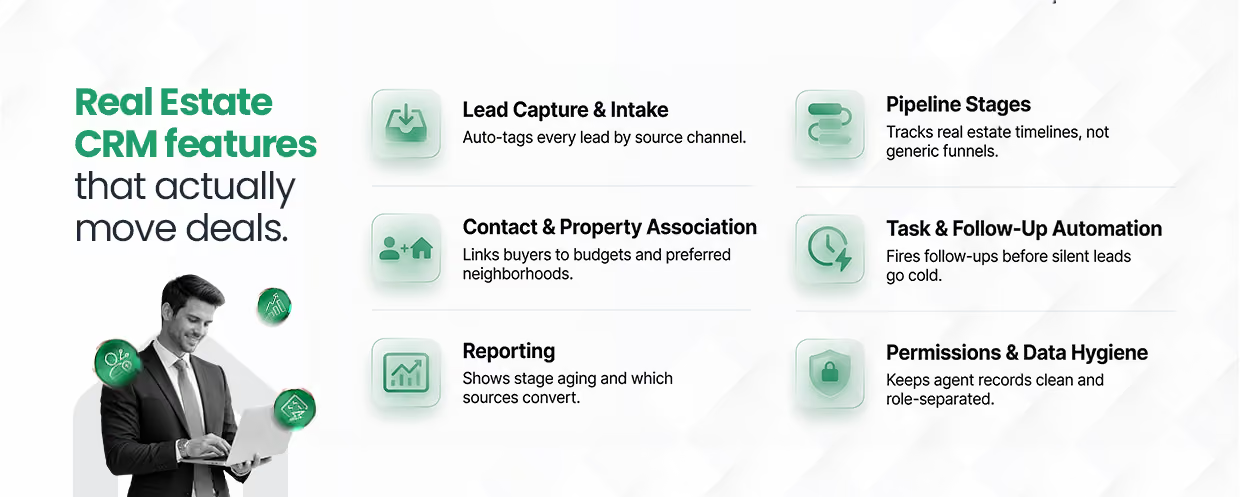
Not every CRM feature is worth your attention. But these are the ones that actually make a difference in day-to-day real estate work:
CRM software was the most used in real estate, making up around 27.4% to 29.5% of the market by late 2025. That says a lot about how central a structured real estate client management system has become to the profession.
The biggest automation mistake in real estate is rushing into it before the foundation is solid. If your contact fields are inconsistent and your stages are vague, real estate workflow automation just accelerates the confusion.
Start with these, they are high-impact and low-risk:
Hold off on these until your data is clean:
61% of high-performing sales leaders actively automate parts of their sales process through their CRM. But the ones getting good results put clean pipeline standards in place first. On the compliance side, consent fields, opt-outs, and change logs are worth adding from day one, not something to bolt on later when a problem comes up.
[H2] Setup Guide: Build Your No-Code Real Estate CRM in 7 Steps
Where most teams go wrong with setup is trying to build the whole thing in one go. Pick a sequence and follow it.
Step 1: Define your pipeline stages and lead sources
Keep 4 to 6 clear stages instead of too many. First, understand how your deals actually move before using any tool.
Step 2: Set up your data properly
Keep contacts, deals, properties, and tasks simple and consistent. Clean data makes everything else easier.
Step 3: Create lead forms
Leads from your website, property portals, and ads should all come into one system with proper source tagging.
Step 4: Set up basic automation
Assign leads automatically, set follow-up tasks, and add reminders when stages change. Every new lead should be assigned and followed up quickly.
Step 5: Build simple dashboards
Track how long deals stay in each stage and which sources bring the best leads.
Step 6: Add AI only after your data is clean
Use it to write follow-ups, clean notes, and spot inactive leads. Without clean data, AI won’t help much.
Step 7: Test and improve
Run the system for a week with real leads, then make changes before fully relying on it.
Teams that want to get through these steps without the back-and-forth of trial and error can use CodeBlox to map the whole workflow, forms, stages, automations, without it turning into a drawn-out build.
{CTA button:Start Building with CodeBlox Today:https://www.codeblox.com/}
Buying a ready-made tool, stitching a few together, or building with no-code each make sense in different situations. Where your process currently stands, and how much you expect it to shift, shapes which path fits.
Run any real estate CRM software through these criteria before committing:
Pipeline flexibility: Can you define your own stages, or are you locked into a preset structure?
Automation depth: Can triggers combine field values, time conditions, and stage changes together?
Integration with your lead sources: Email, calendar, Zillow, and lead ad platforms should connect without manual exports.
Data access controls: Can you restrict agent visibility and give managers a separate reporting view? Reporting and export: Can you pull what you need for performance reviews without a workaround?
Team size shapes the requirements significantly. A solo agent can get by with a simple intake form, five pipeline stages, and a few automated reminders. A growing team needs lead assignment rules, role-based permissions, and reporting a manager can actually use. A full brokerage needs all of that layered with audit trails and compliance-ready data fields.Real estate is not the only industry where relationship-heavy sales cycles demand this kind of structure. See how the same no-code logic plays out in a different context with this overview of a Telecom CRM system.
A lot of real estate firms are already using cloud-based solutions for centralized data management and workflow automation. Teams still running on spreadsheets are not just behind on tools but they are also giving up ground every quarter to agents with faster, more consistent follow-up systems.
AI features, lead scoring, next-step suggestions, smart tagging, draft replies, are going to become more common in real estate CRM software. But all of them depend on the data underneath being clean and consistently structured. What you build into your no-code CRM today is what determines how useful those features actually are when you turn them on.
Governance is no longer a back-burner concern. Clients are paying more attention to where their data goes, and regulators are following. Audit trails, consent records, and access controls are becoming standard expectations, not extras.
No-code makes it far easier to adapt when something changes. New lead source, team expansion, shift in buyer behavior, you update the workflow in an afternoon rather than waiting on a developer. The teams that revisit their pipeline stages regularly, refresh their automation rules when the market shifts, and actually use their reporting to make decisions, are the ones that close consistently. Building a CRM once and leaving it untouched is the most expensive long-term mistake in this space.
{CTA button:Get Started with CodeBlox:https://www.codeblox.com/:Build your no-code real estate CRM with CodeBlox. Set your pipeline, automate follow-ups, and have a working lead management system running this week.}
Find answers to the most common questions about our no-code platform and how it can help you build powerful business application solutions without writing a single line of code.
%20(1).avif)
Tilly leads Operations and Solution Delivery at CodeBlox, partnering with enterprise teams to design scalable business systems before development begins. With hands-on experience across ERP, CRM, finance automation, and industry-specific digital transformation projects, she writes about solution architecture, process optimization, AI-powered workflows, and the practical decisions that determine whether enterprise software succeeds in the real world.
.avif)
%20(1).avif)


%20(1).avif)


.avif)
.avif)
.avif)

.avif)

.avif)
.avif)
.avif)


.png)
.avif)
.avif)
.avif)
.avif)
.avif)
.avif)
.avif)
.avif)
.avif)
%20(1).avif)



.avif)












.avif)
.avif)

.avif)
.avif)

.avif)

.avif)
.avif)

.avif)



%20(1).avif)

.avif)