
- Solutions
- Pricing

“Your system is only as fast as its slowest manual step.”
Most businesses don’t realize this until growth exposes it. When tools multiply and data spreads across apps, workflows that once felt manageable turn into daily follow-ups and manual checks.
The issue isn’t the tools you use. It’s how poorly they are connected with each other.
A no-code integration platform fixes this by automating workflows between apps, connecting systems without coding, and turning scattered tools into a single, scalable business ecosystem.
Most companies have CRMs, accounting tools, support systems, internal dashboards, marketing platforms, and analytics tools. The problem starts when these tools operate in isolation.
Here’s what those gaps look like in day-to-day operations:
None of this feels like a big issue at first. But at scale, these gaps quietly create:
Traditionally, businesses tried to fix this by building custom integrations. Developers would connect systems using APIs, scripts, or middleware. But it got complicated when there were changes in the workflow.
This is why more teams are choosing to connect systems without coding. It is easier to make changes and have fewer dependencies.
A no-code integration platform isn’t just about automation. At its core, it allows businesses to connect different applications, databases, and services using visual logic instead of handwritten code.
For example: When a lead is created → update CRM, notify sales, assign follow-up
All of this happens through configurable workflows, not scripts. No code removed unnecessary friction from integration tasks that don’t require custom development every time something changes.
A good no-code integration platform sits between systems, understands their APIs, and lets teams define logic in a structured, scalable way without writing code.
APIs have always been the backbone of system integration. They allow applications to send and receive data. But APIs also come with complexity like authentication, data formats, error handling, and version changes. This is where integration slows everything down.
Modern API integration tools change that equation. Instead of working directly with raw APIs, teams work with:
The outcome is what matters.
When something changes in one system, others respond automatically. Not because someone remembered to update them but because the workflow was designed to handle it.
This approach shifts focus from technical execution to business logic.
Teams stop worrying about how systems talk to each other and start defining what should happen across the business when something changes. And that’s where real efficiency begins.
{CTA button:Explore CodeBlox Platform:https://www.codeblox.com/solutions/no-code:Curious how a modern no-code platform connects systems visually and scales with your workflows? Explore how CodeBlox helps teams design, manage, and evolve integrations, without writing code.}
Automation often sounds abstract until you look at daily work. Most employees don’t think in terms of apps. They think in tasks.
Tasks like:
A no-code approach allows teams to automate workflows between apps so that tasks flow naturally across systems instead of stopping at tool boundaries.
For example, A lead moves from marketing to sales without a manual handover. Automated workflows don’t forget steps. They don’t skip updates. And they don’t depend on tribal knowledge locked inside a single team.
Most integrations work fine at the beginning.
There are fewer tools. Fewer workflows. Fewer edge cases. A simple connection between two systems feels enough.
Then the business grows.
New teams are added. More tools enter the stack. Processes become layered instead of linear. Suddenly, what was once a quick integration turns into something fragile.
This is where traditional, hard-coded integrations start to show cracks.
A small change like adding a new approval step or modifying a data field can trigger a chain reaction. The issue isn’t the tools. It’s rigidity.
No-code platforms approach scaling differently. Instead of building fixed connections, they rely on modular workflows. Logic is layered, not locked. Each step can be adjusted without rewriting the entire flow. As teams evolve, workflows evolve with them.
Many companies mistake automation for integration.
They automate one task here. Another task there. Each workflow solves a local problem but the overall system remains fragmented.
This is what point-to-point automation looks like:
It works, but only in isolation. A connected business ecosystem is different.
Instead of thinking in isolated workflows, businesses think in flows of information:
No-code platforms like CodeBlox enable this shift because they coordinate systems.
When systems are connected at this level:
This is when integration starts becoming a strategic advantage and not a backend concern.
Engineering teams should be building products, not unblocking internal workflows.
Yet in many organizations, developers spend a significant amount of time updating integrations and fixing broken data syncs.
Every request waits in a queue. Every workflow change competes with roadmap priorities. But with no-code integration platforms like CodeBlox, changes are simple.
They allow non-technical teams to modify workflows, add logic, connect new systems, and more.
Developers stay involved where required while day-to-day integration logic stays with the teams that understand the process best.
Not all no-code platforms are built with scale in mind. Some focus only on simple automation. Others struggle when workflows grow complex or data volume increases.
CodeBlox is designed for businesses that want flexibility and structure. This makes it easier to connect systems without coding while still maintaining clarity, reliability, and performance.
Despite growing adoption, a few misconceptions still hold businesses back.
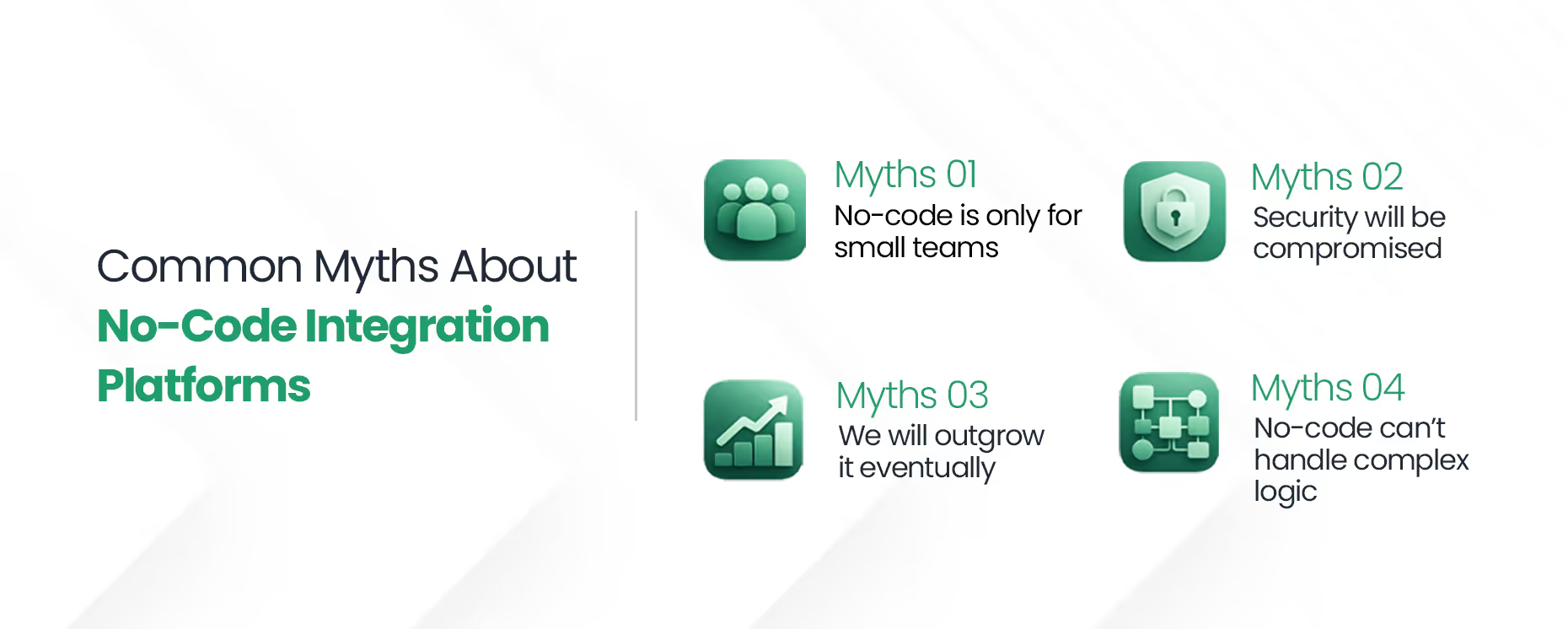
Myth 1: No-code is only for small teams
In reality, scale depends on architecture, not code. Well-designed no-code platforms support complex workflows across large organizations.
Myth 2: No-code can’t handle complex logic
Modern platforms support conditions, branching, data transformations, and multi-step flows without sacrificing clarity.
Myth 3: Security will be compromised
Security depends on platform design and governance. No-code doesn’t mean unmanaged or exposed.
Myth 4: We will outgrow it eventually
Most teams don’t outgrow no-code. They outgrow rigid systems. Flexibility is what allows platforms to scale.
When systems are disconnected, decisions lag. Leaders wait for reports. Teams reconcile numbers. Meetings are spent debating whose data is correct. By the time clarity arrives, the moment has often passed.
Connected systems change that. Instead of reacting to yesterday’s data, teams act on what’s happening now. And that speed compounds as the organization grows.
The question is no longer: Do we need integrations?
The real question is: Who owns them, and how easily can they evolve?
Modern businesses benefit when:
A no-code approach aligns integration with how businesses actually operate - dynamic, cross-functional, and constantly changing. This shift is about enabling the entire organization to move in sync.
Disconnected systems can limit what businesses can become. The ability to automate workflows between apps, adapt processes quickly, and maintain a connected ecosystem is what separates reactive organizations from scalable ones.
No-code integration platforms make this possible. It is not a shortcut, but as a smarter foundation for growth.
When systems are connected, teams focus less on managing tools and more on delivering outcomes. And that’s where real scale begins.
{CTA button:Book a Demo:https://www.codeblox.com/schedule-demo:Ready to connect your business ecosystem and scale without integration limits? See how CodeBlox can fit into your workflows, tools, and growth plans.}
Find answers to the most common questions about our no-code platform and how it can help you build powerful business application solutions without writing a single line of code.



%20(1).avif)