- Solutions
- Pricing

Revenue doesn't disappear from real estate businesses in obvious ways. There's rarely a decisive moment where someone declares a deal lost. Instead, it leaks quietly across the journey through moments that individually look minor but collectively form a damaging pattern.
The leaks usually look like this:
• A follow-up that never happened because no one owned it
• A site visit that failed to convert because the agent lacked context from a prior interaction
• A ready buyer waiting three days for a document approval that should have taken three hours
Most businesses respond to this by adding more tools, when the real fix is addressing the flow. Their real estate software solutions record what happened without controlling what happens next, and that distinction is what separates teams that scale from teams that firefight.
Every deal in real estate travels through a predictable sequence: lead, contact, site visit, negotiation, booking, documentation, and closure. What varies dramatically between businesses is how reliably each transition happens and how visible it is when something stalls.
A real estate management system should do more than store which stage a deal is currently sitting in. It should:
• Enforce what happens when a deal moves from one stage to the next
• Surface delays before they cost an opportunity
• Ensure the right person takes the right action at the right time
When that infrastructure is absent, pipeline reports stop reflecting reality, and managers spend their time chasing updates rather than making decisions.
CRM platforms in real estate tend to function as retrospective logs. Leads get added, notes are written, and pipeline stages get updated after the fact. Recording activity, however, is not the same as driving it forward.
Effective real estate CRM software should:
• Force next actions rather than simply documenting previous ones
• Automatically surface deals that have sat idle past an acceptable threshold
• Trigger escalations when follow-up windows close without action, rather than waiting for a manager to catch it in a weekly review
The CRM should function as an execution engine. When it functions only as a reporting tool, conversion gaps go unnoticed until they've already cost a deal.
Lead management is often treated as a top-of-funnel activity, when in reality it is a continuity problem that spans the entire deal cycle. The point where context gets lost, where a buyer's history is invisible to the next agent they speak with, or where a warm lead gets treated like a cold one because of a handoff gap, is precisely where revenue disappears.
A real estate lead management system has to carry forward:
• Intent signals and engagement history at every agent handoff
• Prior conversation context so no interaction starts from scratch
• Timing data that tells the team when a lead is ready to re-engage
Without that continuity, high-intent buyers experience the process as fragmented and inconsistent, which erodes trust well before any negotiation begins.
{CTA button:Book a Free Demo:https://www.codeblox.com/:See how CodeBlox maps your exact deal flow into an automated system.}
Most real estate organizations operate with a clear separation between sales and operations. From a buyer's perspective, though, the experience is continuous. The following post-sale gaps are where long-term relationships get damaged:
• Poor visibility into post-booking milestones and payment schedules
• Slow responses to documentation queries
• Fragmented communication that leaves buyers without a clear point of contact
Property management software solutions need to extend the customer journey beyond the handshake. Maintaining post-booking transparency, automating document workflows, and keeping buyers consistently informed through the handover phase are what separate businesses that earn referrals from those that merely complete transactions.
Effective real estate teams automatically switch from questioning what went wrong to planning what should happen next. This is the core logic behind real estate workflow automation. Every stage transition triggers a defined next step, delays surface at the system level rather than the personal level, and teams operate on structured triggers rather than informal reminders.
When this logic scales across the entire operation, it becomes real estate business automation in the fuller sense:
• Sales, operations, and finance stop operating in isolated sequences
• Deals no longer lose momentum at handoff points
• Coordination overhead shrinks because the system enforces alignment rather than depending on teams to self-coordinate
No-code development is frequently described as a faster way to build software, but the more significant advantage is operational. No-code workflow software shifts control from technical teams to the operators who actually run the business processes.
In real estate, this matters because workflows are never static. Pricing structures change across projects, lead routing logic shifts with market conditions, and approval sequences evolve as the organization grows. When business teams can modify workflows directly, systems stay current with how the business actually operates without waiting on development cycles to catch up.
Digital workflows also deal with what could be referred to as coordination culture, which is the dependence on manual nudges, calls, and reminders to keep things moving. When execution is system-driven with predefined dependencies, visibility is incorporated into the process rather than being requested via status meetings.
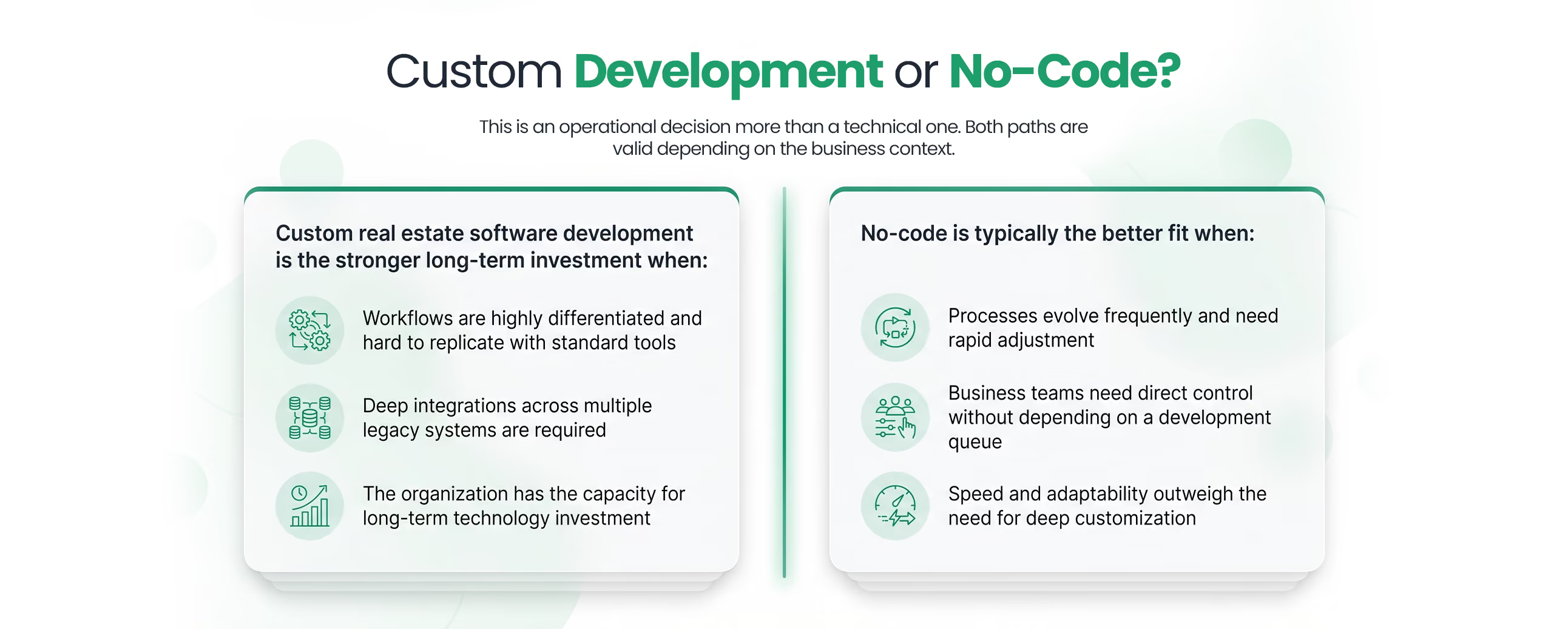
This is an operational decision more than a technical one. Both paths are valid depending on the business context.
Custom real estate software development is the stronger long-term investment when:
• Workflows are highly differentiated and hard to replicate with standard tools
• Deep integrations across multiple legacy systems are required
• The organization has the capacity for long-term technology investment
No-code is typically the better fit when:
• Processes evolve frequently and need rapid adjustment
• Business teams need direct control without depending on a development queue
• Speed and adaptability outweigh the need for deep customization
Cloud-based real estate software is what makes all of the above functional under real-world conditions. Real estate is not a desk-based profession. Sales teams are continuously on the go. The choices are made when buyer intent is high, and data that is not current at the time it is required is virtually useless.
The system facilitates rather than slows down actual transactions as updates to lead status, document approvals, and booking confirmations are sent in real time to all stakeholders, regardless of location.
The most productive way to evaluate real estate automation software is not by counting modules or features, but by tracing the path a deal takes from first contact to final closure and identifying where the system still depends on memory, habit, or manual intervention. Every such gap is a revenue risk.
When those gaps are closed through design, the outcomes are tangible:
• Revenue becomes more predictable because fewer deals fall through process cracks
• Teams stop firefighting and start executing against a defined system
• Customers experience consistency rather than the randomness of person-dependent follow-through
Scaling a real estate business by adding headcount, lead volume, or inventory without considering how deals really move adds operational complexity quicker than revenue. Companies that grow sustainably create systems based on their actual workflows, ensure execution through design, and employ technology to remove the friction that slows progress.
That is what end-to-end real estate software solutions with no-code capabilities unlock: not operational efficiency as an abstract goal, but controlled, predictable growth as a measurable outcome.
CodeBlox helps real estate businesses build automated, no-code workflows that move deals from first contact to final closure without manual gaps.
{CTA button:Start Your Free Trail:https://www.codeblox.com/sign-up}
Find answers to the most common questions about our no-code platform and how it can help you build powerful business application solutions without writing a single line of code.
%20(1).avif)
Tilly leads Operations and Solution Delivery at CodeBlox, partnering with enterprise teams to design scalable business systems before development begins. With hands-on experience across ERP, CRM, finance automation, and industry-specific digital transformation projects, she writes about solution architecture, process optimization, AI-powered workflows, and the practical decisions that determine whether enterprise software succeeds in the real world.
.avif)
%20(1).avif)


%20(1).avif)


.avif)
.avif)
.avif)

.avif)

.avif)
.avif)
.avif)


.png)
.png)
.png)
.png)
.avif)
.avif)
.avif)
.avif)
.avif)
.avif)
.avif)
.avif)
.avif)
%20(1).avif)

.avif)









.avif)
.avif)

.avif)
.avif)

.avif)

.avif)
.avif)
.avif)


%20(1).avif)
.avif)