- Solutions
- Pricing
.avif)
There was a time when workflow automation meant writing a rule and trusting it to hold. That worked until the business grew past the assumptions baked into those rules. At some point, every organization running rule-based automation hits the same wall. That may include the multiplying exceptions along with elongated hours put into maintaining the systems.
That is the gap AI in workflow automation is beginning to fill. It does not sit on top of what already exists. But it changes what actually happens at a decision point inside a process. Gartner forecasts that 40% of enterprise applications will embed task-specific agents by the end of 2026, up from under 5% in 2025. Well, a shift of that size only happens when there is genuine operational pressure behind it! Let’s dig deeper into how AI in workflow automation is making a difference.
Ask anyone who has managed a large rule-based automation system for a few years, and they will all say the same thing. And that is, it starts clean and gets messy fast. You define inputs, write conditions, and outputs follow as designed until a new product line or regulatory change breaks all three conditions at once!
However, AI-powered automation handles this differently. Why? Well, because it does not rely on pre-written conditions the same way. It reads context, weighs what has worked before, and routes or decides based on the current situation. That means when something changes in the business, the system adapts rather than waiting for a human to update the rulebook.
McKinsey's 2025 State of AI research draws a clear line between organizations getting real value from AI and those that are not. And the line they are talking about is none other than the workflow redesign. The ones doing well are going back to the underlying logic and rebuilding it, because slapping new intelligence onto an outdated process never fixes the process itself.
And once you start pulling that thread at enterprise scale, the problem gets significantly bigger than most teams anticipate.
Most people think of workflow automation as a single-department problem. But the truth is that at enterprise scale, it rarely is. Procurement touches finance, and customer service connects to fulfillment. Similarly, a compliance check may need documentation systems, approval chains, and reporting tools simultaneously. Static integrations hold that together up to a point. However, after a point, they become the bottleneck.
This is why enterprise workflow automation is shifting from sequencing tasks to coordinating them. The difference that it makes matters more than what it sounds like. Here is a simple way to think about it:
PwC's AI Agent Survey found governance complexity topping the concern list among organizations actively deploying agents. Not surprisingly, since once an agent handles real operational decisions, the gap between a pilot and a full dependency closes faster than most teams plan for.
If your current setup is already hitting these coordination limits, it is worth exploring how a no-code workflow builder can help you design around them from the start rather than patch them later.
{CTA button:Talk to the Codeblox team:https://www.codeblox.com/contact}
A lot of organizations approach AI integration in business processes as a simple addition. They believe all they do is connect the new tool, let it handle some of the load, and measure the results that it throws. Well, the intent makes sense, but the problems arise only during the execution because it usually does not go as planned.
The problem is that workflows were built with humans making judgment calls at the hard points. When a model takes over, the surrounding logic has to change. A probabilistic output is not the same as a yes/no rule match.
Even fallback paths need to be engineered in from the start rather than retrofitted after the first incident. And if human override points are unclear, you will find out in a situation where it really matters.
Getting AI integration in business processes right means treating the workflow itself as the thing that needs to change and not just the tooling on top of it.
Here is something that does not get talked about enough. A model running on bad data will always produce bad decisions, no matter how well everything else is built. And when that system is handling approval calls at scale, the volume makes it very easy to miss the point where outputs start going wrong.
The failure patterns tend to be the same across most deployments. Data sources that are not updating in real time mean the model is working off a stale picture. When there are no feedback loops in place, the model has no way to course-correct from its own mistakes. And when data structures are inconsistent across systems, the model ends up interpreting the same information differently depending on where it came from. None of this triggers an error. It just quietly erodes the quality of every decision the system makes.
For teams still in the early stages, no-code databases can speed up the experimentation process without needing engineering input at every turn. But for any AI integration in business processes running in production, data governance is not optional, regardless of how the workflow was first built.
Some industries are further along than others. That’s generally where processes are complex and high-volume, which is where rule-based logic breaks down most visibly.
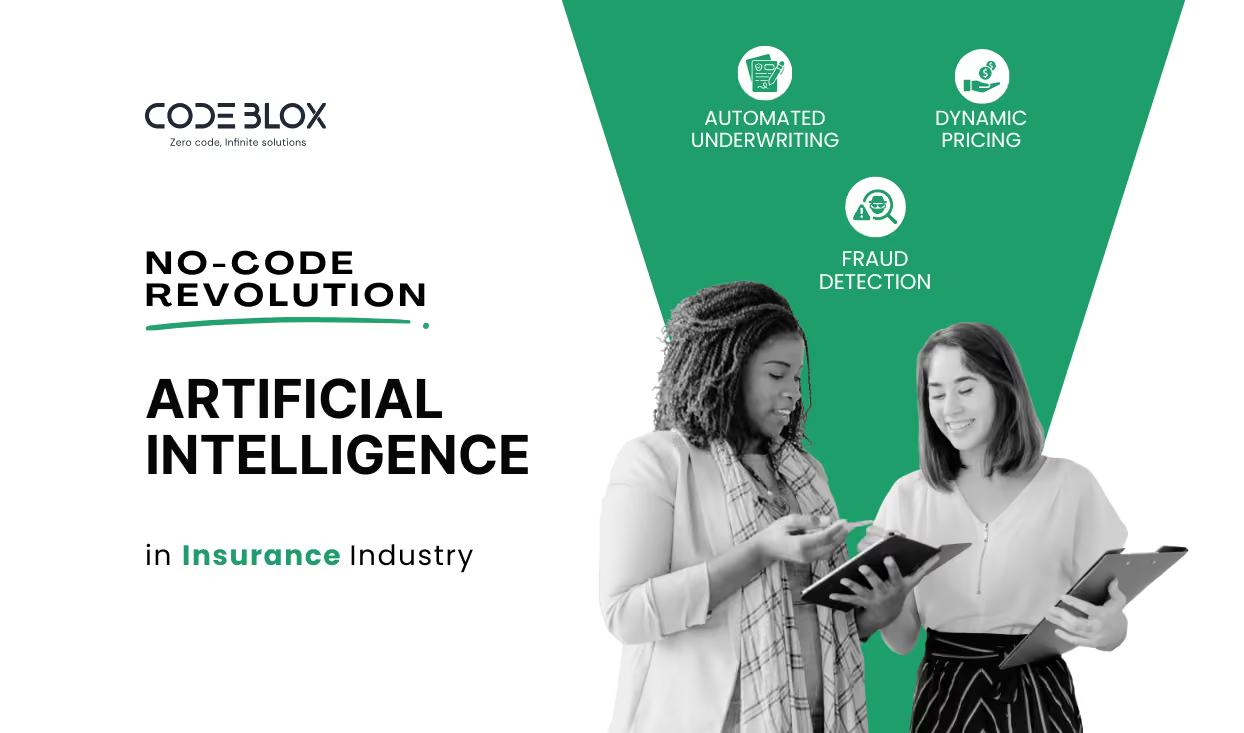
Insurance is the clearest example. Claims triage, underwriting, and fraud detection all involve large volumes of context-sensitive decisions where edge cases are expensive. Rule engines could not keep up with the range of scenarios, so moving to context-aware logic has reduced processing times and improved accuracy in real deployments. The operational picture is covered in more depth in this piece on AI in the insurance industry.
Healthcare presents a related challenge. A research was published in 2025 which examined how clinical teams coordinate tasks across care pathways. Thy foound out that keeping workflows aligned across teams has historically depended on constant manual oversight. The research points to adaptive routing as a way to reduce that dependency, allowing care coordination to run with less human intervention at every handoff.
In financial services, anomaly detection and compliance routing both suffer from fixed thresholds generating too many false positives. Systems evaluating patterns in context perform more accurately, which at scale translates to meaningful overhead reductions.
The risk conversation around AI in workflows focuses on security, but the more common problem in practice is model drift. Put simply, it means the gradual divergence between what a model was trained on and what it encounters in production. In a workflow context, this is hard to catch since there are no errors and no failed processes. It is just a routing decision that was correct six months ago, becoming progressively less correct as the business changes around it.
Catching drift requires decision-level logging rather than just workflow-level logging. Furthermore, it requires regular comparison of outputs against actual outcomes and explainability. But that is not all! It also requires the ability to look at a specific output and understand why the model produced it.
Without these built in from the start, governance ends up being reactive!
Before committing to this kind of deployment, the questions worth spending time on are architecture questions rather than product questions. Most deployment failures trace back to infrastructure and design choices nobody asked about during procurement.
Ask these questions:
And human override, which is often left underspecified, needs real thought too. The points where a person can step in and correct a decision have to be visible and reachable. That is simply because a system that treats human intervention as an edge case will eventually make timely intervention impossible. Asking these questions will help you determine whether the deployment holds up or not.
The way AI is being used inside businesses is shifting fast. Gartner's research points to a world by 2029 where multiple AI agents work together across different platforms and departments, not in isolation. And McKinsey's findings back this up. The businesses seeing the best results are not running AI as a one-off project anymore. They have made it a core part of how they operate day to day.
What does that mean for you? Well, it means that the businesses that are building now with static processes and rigid systems will have to go back and rebuild later. The ones that design their workflows with flexibility and proper governance from the start will not have to. Model drift, compliance gaps, and integration failures are not surprises that come out of nowhere. They are the result of decisions made too early without enough thought about what comes next. Getting that foundation right today is what separates businesses that scale their automation from the ones that stall trying to.
Most technology decisions are about adding something new to what already exists. This one is different. When you change the decision-making layer inside a process, everything around it shifts too. The process logic, the data design, the way integrations work, the monitoring, the governance. All of it.
Businesses that treat this like a regular software purchase keep running into the same wall, where what the technology does in their environment does not match what they expected. The ones that approach it as a design problem from the start tend to build something that actually holds up.
Codeblox is built differently! It is not another automation tool but a no-code platform that lets businesses build fully customized AI workflow applications without writing a single line of code. It also covers everything from CRM and operations to compliance and reporting, all within a single unified system.
If you are thinking seriously about how intelligent automation fits into your enterprise workflows, that is exactly the kind of foundation worth building on.
{CTA button:Contact Us:https://www.codeblox.com/contact}
Find answers to the most common questions about our no-code platform and how it can help you build powerful business application solutions without writing a single line of code.
%20(1).avif)
Chris has spent more than a decade designing and delivering enterprise software for organizations with complex operational requirements. Drawing from real implementation experience, he writes about enterprise architecture, CRM strategy, digital transformation, software modernization, and the challenges organizations face when scaling business operations.
.avif)
%20(1).avif)

%20(1).avif)

.avif)
.avif)
.avif)

.avif)
.avif)
.avif)


.png)
.png)
.png)
.png)
.png)
.avif)
.avif)
.avif)
.avif)
.avif)
.avif)
.avif)
.avif)
.avif)
%20(1).avif)

.avif)




.avif)
.avif)
.avif)
.avif)
.avif)

.avif)
.avif)
.avif)
%20(1).avif)
.avif)