- Solutions
- Pricing

The global pharmaceutical CRM software market was valued at about USD 3.21 billion in 2025 and is projected to reach USD 13.8 billion by 2034, growing at nearly 17.6% CAGR.
The growth shows that the industry has finally admitted its existing systems can’t keep up.
Across hospitals, clinics, and pharma teams, the same pattern shows up: critical patient information scattered across tools, follow-ups handled manually, compliance tasks slipping through cracks, and workflows that change faster than traditional CRM for pharmaceutical industry can adapt.
The industry was struggling because the systems supporting them were never built for this level of complexity.
Modern care delivery demands something far more flexible, a CRM for pharmaceutical industry workflows that can manage patient journeys, coordinate teams, meet compliance requirements, and still evolve without a full-blown IT project every time a new rule or protocol appears.
This is where the shift is happening. Healthcare providers are moving away from rigid, one-size-fits-all CRMs and toward platforms they can shape themselves. Platforms where patient records, workflows, reminders, documentation, and compliance checks can be built the way their organisation works and not the other way around.
This blog breaks down why healthcare needs a different kind of sales software for pharmaceutical industry, how compliance reshapes requirements, and why no-code is becoming the most practical way to manage patients with consistency, accuracy, and far less operational chaos.
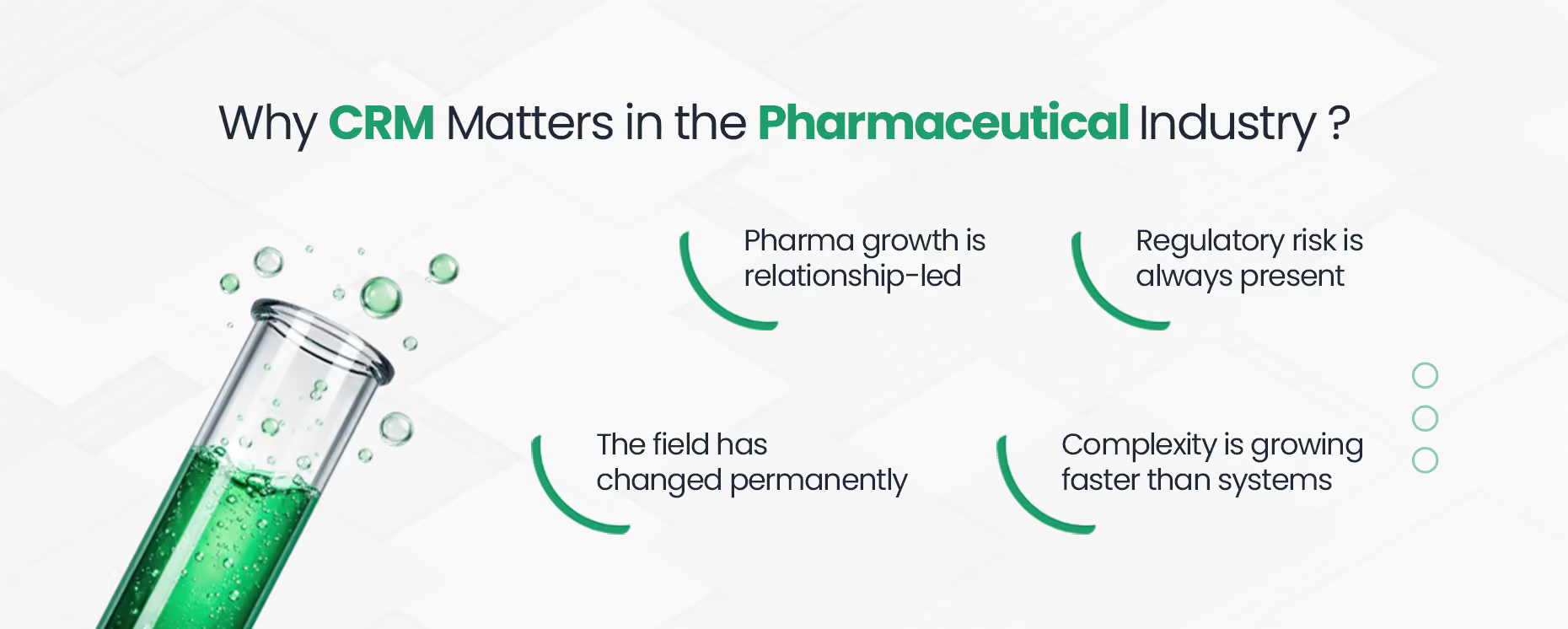
The pharmaceutical industry operates under constant pressure from three directions i.e., revenue expectations, regulatory enforcement, and evolving HCP engagement models. A CRM sits at the intersection of all three.
1. Pharma growth is relationship-led
Unlike many industries, pharma doesn’t sell directly to end consumers. Growth depends on long-term, trust-driven engagement with healthcare professionals.
Without a CRM, growth becomes personality-driven. With a CRM, it becomes system-driven.
2. Regulatory risk is always present
Pharma companies operate in one of the most regulated environments globally. Every interaction, every promotional piece, every sample, all of it is reviewable.
When workflows are scattered across tools, compliance becomes reactive.
When managed through a structured CRM, compliance becomes proactive.
3. The field has changed permanently
Pharma engagement is no longer purely face-to-face. Hybrid detailing, virtual meetings, webinars, digital content consumption, all influence prescribing behavior.
But if engagement data is managed on a different systems, leadership will miss out on what truly drives results.
The CRM centralizes visibility which helps change decision-making.
4. Complexity is growing faster than systems
New brands launch.
New regulations appear.
New reporting requirements emerge.
New engagement models evolve.
Traditional CRM systems struggle because they were built for stability. But this industry needs flexibility.
That’s why CRM in pharma is no longer just operational software but it is a strategic infrastructure.
If you are serious about CRM for pharmaceutical industry, your CRM should enable:
Pharma operates in a landmine of rules:
CRM must enforce these rules.
A real CRM pharma industry data model includes:
Field-force enablement that actually works
The right CRM enables:
Your CRM should automate and track:
You should know this about your CRM:
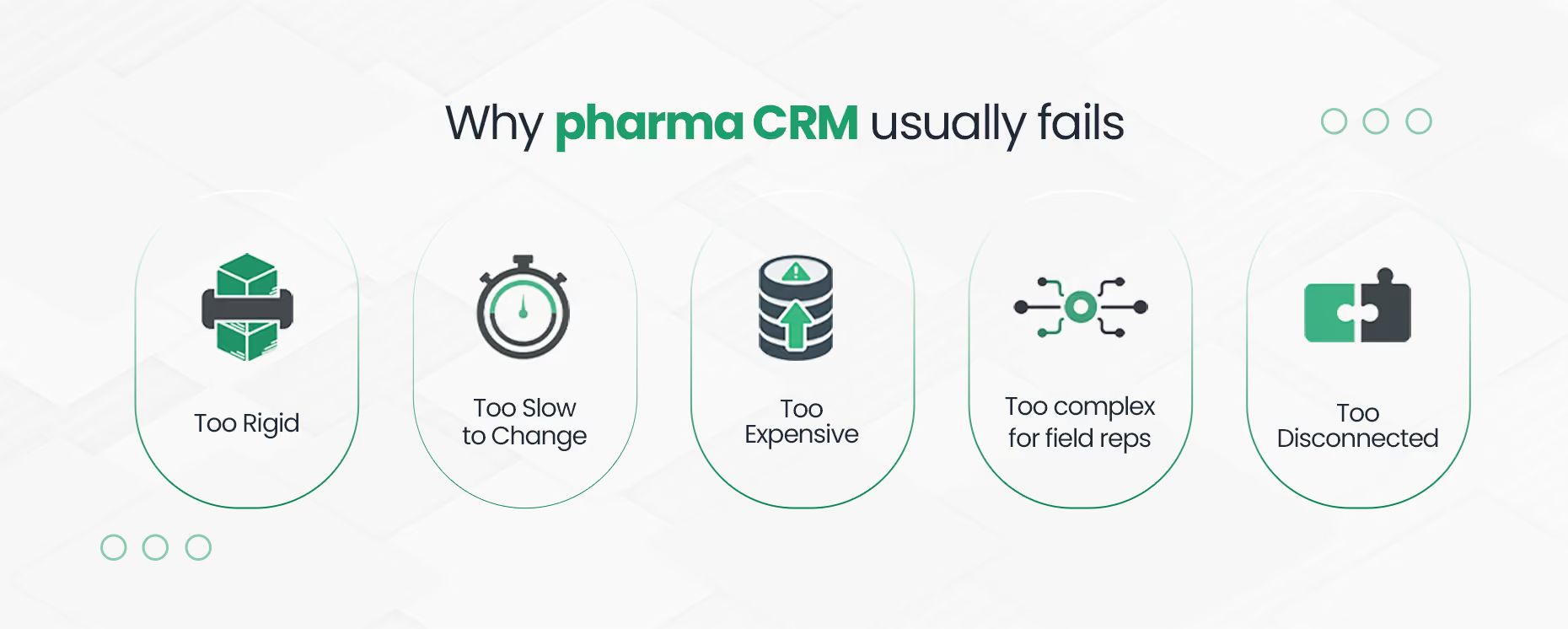
Most pharma CRM failures have the same root causes:
Vendors lock companies into predefined data models, approval workflows, and activity types that don’t match how their teams operate.
Every small compliance tweak becomes a multi-week engineering task.
Enterprise CRM + mandatory add-ons + implementation partners = high burn with slow results.
If logging into the sales software for pharmaceutical industry is complicated, staff will hesitate to adopt it.
Separate tools for all operations with no shared data backbone.
This is where the shift to no-code CRM becomes a strategic advantage.
Pharma workflows are unique, and there are constant changes in regulations. Medical/legal teams constantly update rules. A no-code CRM solves this by giving control to business teams. With no-code, pharma companies can:
HCP, institution, rep visit, sample, adverse event, promotional content, every object is fully customizable.
Multi-level medical review
→ legal validation
→ promotional sign-off
→ release to field teams
…all built visually.
Lot tracking, quantity limits, automatic reconciliation prompts, and region-based permissions.
Your SOP changed?
Your regulator wants a new field logged?
Your medical team added a new restriction?
Update the workflow from no code backend and you are good to go.
This flexibility is exactly why pharma is leaning toward no-code architecture.
{CTA button:Explore CodeBlox:https://www.codeblox.com/solutions/no-code:<h3>Want to build your own CRM with a no code platform?</h3>}
CodeBlox is NOT a prebuilt pharma CRM. It is a no-code platform where pharma companies can create and customize their CRM just the way their commercial, medical, and compliance teams need it.
Because it gives control back to the business.
The CRM adapts to your company, not the other way around.
Just the only approach that actually works in pharma:
Usually:
Pick one. Build only that.
A few reps. One compliance manager. A brand lead.
Gather feedback.
Change the workflow. Add a field. Modify an approval step.
Fix friction points.
Sales analytics, content management, MSL workflows, etc., layer them gradually.
This modular growth model works because CodeBlox lets teams build and adapt everything visually, as many times as they need.
Use this internally; it will make your team’s life easier:
If any answer is NO, you don’t have the right CRM, which will create trouble in future.
The pharma industry is too regulated, too dynamic, and too specialized for generic CRMs.
And too fast-moving for rigid, code-heavy systems.
Which is why the future isn’t prebuilt pharma CRMs. The future is pharma companies building their own CRM, compliant, customized, modular, on no-code platforms.
And CodeBlox is the platform that gives them that power.
You decide the workflows.
You design the data.
You choose the modules.
You evolve at your speed.
{CTA button:Book a pesonalised demo:https://www.codeblox.com/schedule-demo:<h3>Ready to build a CRM that fits your pharma sales and compliance workflows?</h3>}
Find answers to the most common questions about our no-code platform and how it can help you build powerful business application solutions without writing a single line of code.
Traditional CRMs are rigid, expensive, and slow to change. A no-code CRM lets pharma teams update compliance rules, modify approval flows, and add new modules. It lets them adjust engagement processes instantly without developers or vendor lock-in.
Because everything is built visually, teams usually launch their first module, like HCP call logging or sample tracking, in days. They can then expand into approvals, MSL workflows, PV logs, or omnichannel modules whenever ready.
Yes. Enterprise-grade no-code platforms offer encryption, role-based access, audit logs, field-level permissions, environment separation for medical/legal review, and compliant integrations. As long as these controls exist, no-code can be fully pharma-ready.
A pharma CRM tracks all the operations in one place. This helps brands build consistent, compliant HCP journeys across online and offline touchpoints.
Modern CRMs allow reps to log sample requests, record lot/batch details, enforce quantity limits, and trigger automatic reconciliation reminders. This creates a clean audit trail and aligns perfectly with regulatory expectations around sample accountability.
%20(1).avif)
Tilly leads Operations and Solution Delivery at CodeBlox, partnering with enterprise teams to design scalable business systems before development begins. With hands-on experience across ERP, CRM, finance automation, and industry-specific digital transformation projects, she writes about solution architecture, process optimization, AI-powered workflows, and the practical decisions that determine whether enterprise software succeeds in the real world.