
- Solutions
- Pricing

The CRM market touched $73.40 billion in 2024 and continues to grow at a pace very few enterprise software categories can match.
Analysts expect it to cross $163.16 billion by 2030, and while sectors like retail and SaaS have driven early adoption, the last few years have revealed a surprising reality: manufacturers are now among the highest-intent CRM buyers.
CRM for manufacturing industry has evolved into a very different category from traditional customer-facing CRM. And it’s exactly why a growing number of manufacturers are no longer buying rigid, one-size-fits-all CRMs. Instead, they’re building their own CRM systems using platforms like CodeBlox that allow them to design complex relationships, RFQ flows, quote logic, service processes, and operational interactions, all in no-code.
This shift is not small. It’s a complete rethinking of what CRM should be inside a factory-driven business.
Let’s break down why.
How CRM in manufacturing is different compared to other industries
If you sell physical products, especially engineered or configurable ones, CRM cannot be treated as a glorified contact database. The use of CRM in manufacturing industry spans far beyond sales. It includes engineering, logistics, service teams, distributors, etc. One commitment made in CRM has ripple effects across the entire chain.
This is why manufacturers struggle with generic CRMs. They are designed for high-velocity sales environments. Manufacturing sales cycles often involve:
The moment the quote is approved, everything moves downstream to planning, procurement, and production. One misstep at any point can kill trust, margins, or delivery schedules.
Most CRMs simply aren’t built for this level of nuance. They weren’t created for an environment where a single wrong field, a poorly managed revision, or a missing approval could derail an entire order.
This is exactly where the new category emerges crm manufacturing industry systems that are not just sales tools but operationally aware platforms.
Walk into most manufacturing companies, and you will find the same story repeating:
The CRM manages some data.
The ERP manages other data.
The real workflow lives in emails, spreadsheets, and people’s heads.
That gap between CRM and manufacturing operations is growing impossible to ignore.
Traditional CRMs require months of customization to even approximate a manufacturing workflow. Even then, every change requires another development cycle. Manufacturers evolve their processes constantly be it product lines change, pricing structures shift, distributor policies update, approval flows adjust, engineering inputs evolve. CRM must evolve with these changes, but legacy CRM systems don’t move fast enough.
This friction is why manufacturers are shifting to building CRM on no-code platforms like CodeBlox. When you build CRM yourself, the system fits the way you sell, quote, plan, and serve. Not the other way around.
In CodeBlox, manufacturers can create:
All without writing code.
This is why the conversation about the best CRM for manufacturing industry has fundamentally changed. The best CRM isn’t the one with the most modules. It’s the one that fits your process. And increasingly, the CRM that fits your process is the one you build yourself.
{CTA button:Explore CodeBlox:https://www.codeblox.com/solutions/no-code:<h3>Build a CRM That Fits Your Factory</h3>Give your sales, operations, and service teams a CRM that matches how they actually work. See how CodeBlox lets manufacturers design complete CRM systems with no code.}
Manufacturers don’t buy CRM because they want better pipeline hygiene. They buy it because they want fewer surprises.
A typical manufacturer might deal with an OEM headquartered in Europe, a plant in Pune, a distributor in Dubai, and an end customer in Kenya. All of them are interconnected. All of them have different commercial terms, payment rules, documentation requirements, and service histories. CRM must reflect this multi-layered reality.
CodeBlox allows manufacturers to build this hierarchy exactly the way their business actually works: parent companies, sub-companies, plants, partners, distributors, dealers, all connected through business logic.
Manufacturing RFQs aren’t casual leads. They are serious, structured, deadline-driven opportunities with drawings, spec sheets, standards, certifications, and expected delivery timelines. One RFQ can shift production plans for an entire week.
Traditional CRMs expect RFQs to be “opportunities.” That oversimplifies the complexity.
CodeBlox enables manufacturers to build an RFQ intake system for technical reviews, clarifications, engineering involvement, revision cycles, internal notes, and version history. Nothing gets lost. Nothing gets buried in email threads.
Every manufacturing quote carries operational weight. A quote isn’t just a price. It’s a commitment to lead time, compliance, raw material assumptions, production capacity, and delivery risk.
In most manufacturers, quoting is a tangled process: sales, engineering, finance, management, and operations all jump in. The approval trail becomes a mixture of emails, spreadsheets, and someone shouting across the office.
With CodeBlox, manufacturers build their own quoting engine. Margin rules, validation formulas, approval chains, version control, etc. is modeled inside their self-built CRM.
Once a quote is accepted, things get real. ERP needs to know the order. Production needs the specs. Procurement needs lead times. Quality teams need documentation. Dispatch needs priorities. Customer service needs clarity.
When CRM isn’t integrated or operationally aware, this handoff becomes absolute chaos.
Manufacturers use CodeBlox to create the exact quote-to-order flow they want. They define when ERP gets triggered, who gets notified, how documents flow, and what conditions unlock downstream steps. Every order moves with clarity. Every commitment is trackable.
Manufacturers live or die based on long-term trust. Installations need maintenance. Machines need service. Components fail. Spare parts are urgent. Service history is often more valuable than sales history.
CodeBlox allows manufacturers to build service modules into their CRM, assets, warranties, service tickets, field visits, parts, checklists, customer acknowledgments. All tied directly to the same customer record that began as an RFQ.
This is real customer relationship management in manufacturing industry. It doesn’t care about fancy marketing features. It cares about operational truth.
CRM in manufacturing is not a cost-saving tool. It’s a risk-reduction and growth protection system.
Every mistake avoided, a wrong quote, a missed approval, a lost document, a mis-synced order, directly impacts revenue. Every piece of clarity gained builds customer confidence. Manufacturers choose vendors they trust more than vendors who sell the cheapest.
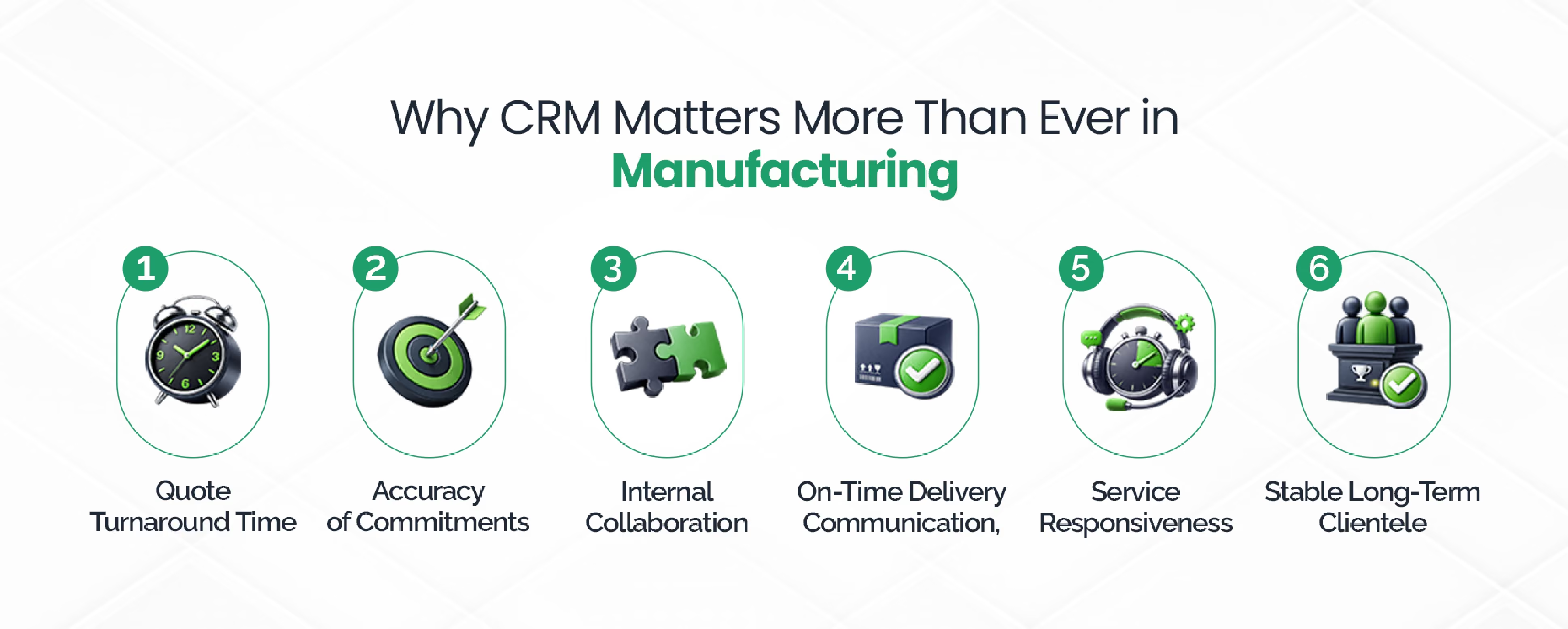
A well-designed manufacturing CRM improves:
When manufacturers build CRM using CodeBlox, they also avoid the endless customization bills of traditional CRMs. Workflows evolve in hours, not months. Sales and operations finally work off the same truth.
The ROI isn’t theoretical. It’s visible in every RFQ, every approval, every handoff, and every customer interaction.
Let’s be unambiguous here.
CodeBlox helps manufacturers build their own CRM.
Not extend one.
Not patch one.
Not integrate with a CRM.
Build it.
For manufacturers who hate the rigidity of traditional CRM systems, CodeBlox becomes the platform where they construct:
And they build all of this on a visual, no-code environment designed for speed, agility, and change.
This is why CodeBlox is becoming central to discussions around crm for manufacturing industry. Because manufacturing doesn’t need a textbook CRM. It needs a CRM shaped around how factories operate, how engineers think, how sales negotiate, and how service teams maintain relationships.
CodeBlox gives manufacturers the freedom to build precisely that.
Manufacturing CRM is not like any other CRM category. It demands operational awareness, deep customization, technical workflows, and flexible logic. It also demands a system that evolves constantly because manufacturing never stands still.
The best CRM for manufacturing industry is no longer a single off-the-shelf product. It’s the CRM a manufacturer builds tailored to its RFQ cycles, quoting rules, approval hierarchies, order workflows, service models, and distributor networks.
That’s exactly what CodeBlox enables a complete, custom-built CRM system for the manufacturing lifecycle built visually, without writing code.
{CTA button:Book a Demo:https://www.codeblox.com/schedule-demo:<h3>See a Custom-Built Manufacturing CRM in Action</h3>Get a tailored walkthrough of RFQ workflows, quoting, order flows, and service modules designed inside CodeBlox.}
Find answers to the most common questions about our no-code platform and how it can help you build powerful business application solutions without writing a single line of code.



%20(1).avif)