Crafting exceptional software solutions exclusively designed for your business needs. Learn More
How to Reduce Administrative Burden in Healthcare With Automation

Healthcare professionals do not enter the field to spend half their workday filling out forms. And yet, that is precisely where most of their hours go. Even research mentions that clinicians across specialties dedicate close to 50% of their working time to documentation, data entry, and administrative follow-up. In short, that means that the staff spends more time doing the irrelevant “desk job” rather than taking care of patients, which they were basically trained for!
Researchers and hospital administrators have started calling this the "hidden shift." It is similar to having a second job that runs along with the clinical practice. It gradually lowers the employee morale and the standard of care that patients actually receive.
These difficulties do not stem from unusual circumstances but from the routine hospital work. Common tasks like billing, scheduling, verifying insurance, and compliance paperwork are a few examples because these are repeated thousands of times every single month, in possibly every hospital out there. When everything is done by hand, it's easy for delays to happen, affecting the team's everyday efficiency.
At CodeBlox, we take a simple, pragmatic approach to this. The goal of automation in healthcare is not to replace human workers but to eliminate the monotonous activities that impede team productivity. Look at it this way! When all these processes are handled 'automatically,' clinicians have more time to focus primarily on patient care that they are actually supposed to do.

Healthcare Automation in 2026
Healthcare automation in 2026 is more about making the existing systems to work together. Considering that we now have technologies like no-code platforms and AI, a majority of hospitals still continue to use distinct tools for everything, like electronic health record (EHR) systems, billing tools, scheduling platforms, and compliance software.
So what happens in practice is simple. A patient checks in, and their details get entered into one system. Then someone has to enter the same information again for billing, and again for insurance. It is repetitive work, and it slows things down more than people expect.
Every extra step adds time. It also increases the chances of small mistakes, which then create even more back-and-forth later.
The 2026 HIMSS Report on Digital Health reflects a clear industry move toward automated governance frameworks. That means that more and more organizations are adopting healthcare workflow automation that can help them manage the full patient journey.
And this change has a big impact on efficiency, believe it or not! Let’s understand it this way—a basic automation can handle only one action, say, sending a reminder message. A healthcare workflow automation, on the other side, is capable of managing the full process, from patient intake and insurance approval to billing and follow-ups. And the best part is that it doesn’t need staff to handle each step manually.
4 Key Areas for Healthcare Process Automation
These are the core areas where healthcare process automation can reduce delays and improve daily operations.
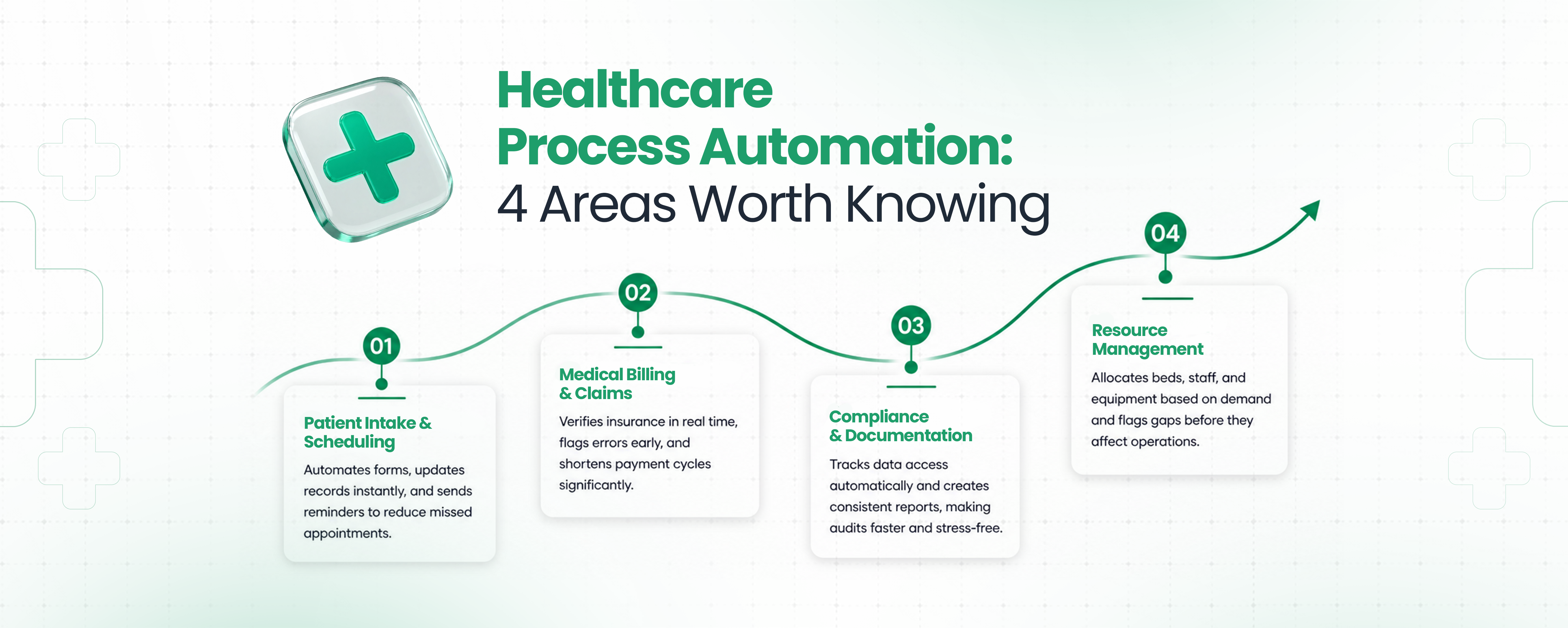
1. Patient Intake and Scheduling
Automated intake can easily eliminate working with digital forms and making manual entries. It can update patient records instantly using the forms. The scheduling systems can also minimize missed appointments by sending reminders via SMS, email, and other essential apps.
2. Medical Billing and Claims
The system verifies insurance in real time and reviews claims for inaccuracies when providers automate healthcare billing processes. As a result, payment cycles shorten, and denials reduce. And that is how teams can zero in on exceptions instead of routine submissions.
3. Compliance and Documentation
Automated audit trails can quietly track who accessed or updated data in real time. So, the compliance is taken care of without adding extra work. On top of that, documentation workflows help teams create consistent reports, making audits quicker and far less stressful to manage.
4. Resource Management
Finally, hospital workflow optimization improves how beds, staff, and equipment are allocated based on patient demand. It makes sure that resources are used efficiently while systems flag gaps early enough, before they start impacting the operations.
Manual vs. Automated Healthcare Workflows
The difference becomes clearer when comparing how everyday processes function in manual environments versus automated systems.
What this really means is fewer repeated steps and less manual coordination for teams to deal with. As a result of this, processes move faster and with fewer mistakes. The processes also stay consistent across the board and over time; that adds up to smoother patient flow and better use of staff time.
Are you still working with a spreadsheet? Start simplifying operations with healthcare automation designed for real clinical environments. Build your first no-code healthcare AI solution today!
Talk to Experts
How AI Helps With Healthcare Administration
AI in healthcare administration works best when it supports daily operations instead of replacing human decision-making. It helps hospitals in managing massive data volumes, predicting patterns, and acting quickly. This increases the significance of healthcare automation and improves team time, resources, and patient interaction.
Hospitals, for instance, can use AI to predict busy times and prepare staff in advance instead of reacting later. It can also identify patients who are likely to miss appointments and trigger reminders automatically. Healthcare workflow automation makes these operations, which are challenging to handle manually at scale, more efficient.
How does it support healthcare operations overall? Well, this is how:
- It predicts patient volume to improve hospital workflow optimization
- Identifies no-show risks and triggers timely follow-ups
- Reduces manual workload through healthcare process automation
- It improves planning and coordination across departments
- Additionally, supports faster and more accurate administrative decisions
CodeBlox approaches this a bit differently. We don't make teams deal with technical setups. Instead, it focuses on keeping things simple. Using custom workflow automation, processes can be created through straightforward visual interfaces, where teams connect systems, define how things should work, and automate actions as data updates in real time.
- Managing healthcare IT solutions without using any code
- Set up automated workflows and alerts easily
- Connect multiple systems into one workflow
- Enable teams to automate healthcare processes without engineering support
This non-complicated approach makes sure that AI in healthcare administration doesn’t just stay limited to large organizations with technical teams. It becomes accessible, scalable, and useful for everyday hospital operations.
Building the Right Setup for Hospital Automation Solutions
Hospitals can use healthcare automation without replacing the ones they have now. Instead, through secure integrations, new tools can link to existing platforms, including EHR, billing, and scheduling systems. Because of this, hospitals are able to enhance their workflows without having to make new investments.
Cloud-based hospital automation solutions simplify operations management for growing hospitals and multi-location clinics. Workflow or compliance rule updates can be implemented instantaneously across all the websites, eliminating the need for separate IT support at each location. Starting with one high-impact area, like scheduling or billing, and expanding based on outcomes is a sensible strategy.
Here’s how hospitals can start:
- Connect existing systems using healthcare IT solutions
- Start with high-impact areas like billing or scheduling
- Use cloud-based systems for easier multi-location management
- Expand automation gradually across departments
- Improve coordination through healthcare workflow automation
The Cost vs. Value of Healthcare Automation
The value of healthcare process automation can be seen in both cost savings and operational improvements. When hospitals automate healthcare processes like data entry, claims handling, and documentation, they reduce the time spent on repetitive work and lower administrative costs.
At the same time, fewer billing errors lead to faster payments and more predictable revenue cycles. Better scheduling and follow-ups improve patient experience, which helps with retention and overall efficiency.
A 2025 paper published on IEEE Xplore highlights that combining automation with strong data management improves both operational performance and data control. This aligns with how modern healthcare automation systems are designed to support both efficiency and reliability.
These are the key areas where automation creates measurable value:
- Reduced manual work and administrative costs
- Faster billing cycles with fewer errors
- Improved patient experience and retention
- Better data handling through healthcare IT solutions
- Scalable systems using hospital automation solutions
Overall, automation in healthcare industry settings helps hospitals run more efficiently while maintaining control over operations and data.
The Road Ahead with Codeblox
Administrative burden in healthcare is not just an inconvenience. It affects how hospitals operate, impacts staff workload, reduces care quality, and creates ongoing financial strain. This is why healthcare automation and healthcare workflow automation need to be treated as core operational strategies, not optional improvements. Organizations that take this approach are better positioned to support their teams and maintain consistent performance as demands continue to grow.
The next step does not require a full-scale technology overhaul. It starts with identifying the one process that takes the most time each week and improving it through healthcare process automation. With the right approach, even small changes can lead to meaningful improvements. CodeBlox's workflow automation platform is built to make that first step practical and every step after it scalable.
{CTA button:Try It For Free:https://www.codeblox.com/sign-up}
Frequently Asked Questions
Find answers to the most common questions about our no-code platform and how it can help you build powerful business application solutions without writing a single line of code.
What is the future of automation in healthcare administration?
The future centers on AI in healthcare administration and predictive modeling. We are moving toward hospital workflow optimization, where systems don't just react to data but actually forecast patient volumes and staffing gaps, allowing hospitals to be proactive rather than reactive.
How does automation help with medical billing?
When clinics automate healthcare processes within their billing department, systems can perform instant eligibility checks and error detection before a claim is even submitted. This precision reduces denial rates, accelerates the reimbursement cycle, and removes the need for manual verification on every file.
Can automation improve patient care?
Yes. By deploying healthcare process automation to handle background paperwork, clinicians can spend significantly more time in direct consultation with patients. Additionally, automated follow-up alerts help improve treatment adherence, ensuring patients remain engaged with their care plans between scheduled visits.
Does CodeBlox provide real-time analytics for healthcare operations?
Yes. Healthcare IT solutions built on Codelox feature live dashboards that monitor patient flow and billing cycles as they happen. This gives hospital managers the ability to make immediate, data-driven adjustments to operations instead of waiting for traditional end-of-month reports.
What types of automation are used in healthcare administration?
The most effective hospital automation solutions include AI-powered medical coding, automated patient scheduling, and real-time inventory tracking. These tools function as an "invisible back office," managing electronic prior authorizations and claim scrubbing without requiring constant manual oversight from administrative teams.


