- Solutions
- Pricing

These days, telecom companies are more than just connectivity providers. The sector is evolving into a more comprehensive digital service provider that oversees experiences rather than just pipes.
With the 5G rollout and rising customer expectations, some of the biggest roadblocks slowing growth aren’t network capacity. They are the silos sitting between your systems.
Consider what happens the moment a customer signs up for a new service. That data needs to travel from your CRM into provisioning, into billing, into network activation.
In most telecom environments, parts of that journey are still manual. Operators copy data between screens, teams wait on each other, and somewhere in that handoff chain, orders break before services ever go live.
The industry calls this "order fallout," and it's one of the primary reasons telecom sees annual churn rates between 20% and 31%, according to CustomerGauge's B2B benchmarks report.
The model the industry is building toward is what analysts call the "Lean Telco," an operation where telecom system integration removes the manual glue between systems and lets data move in real time, end to end.
Telecom digital transformation is the shift from siloed, manual operations to connected systems that enable real-time data flow and automation across the business.
But before we get into what to automate, it's important to understand why the pressure to integrate has reached a tipping point and why the time to act is closing.
The "swivel-chair" effect is the informal name for what happens when an operator has to toggle between multiple tools to complete a single task, manually re-entering data that should have flowed automatically.
In a 5G environment where service configurations are more complex and customer expectations are higher, manual processes are not just inefficient.
They lead to errors, create backlogs, and slow down every process that impacts the customer. Operators who still rely on these workflows carry a structural burden that more integrated competitors do not have.
Real-time data flow between your front office and your back office is what telecom digital transformation is actually built on.
Your operations become more proactive instead of reactive when:
Each integration reduces friction, and that friction directly impacts time, revenue, and customer trust.
This is also where telecom process automation turns connected systems into workflows that run without manual intervention.
Because telecom system integration is the mechanism behind agility. When systems are integrated, your business can respond to a customer request, a network fault, or a billing exception without waiting for a person to move data from one screen to another.
In an industry where poor support experience drives 39% of customers to switch providers, operational speed is not a back-office concern. It directly determines whether customers stay or leave.
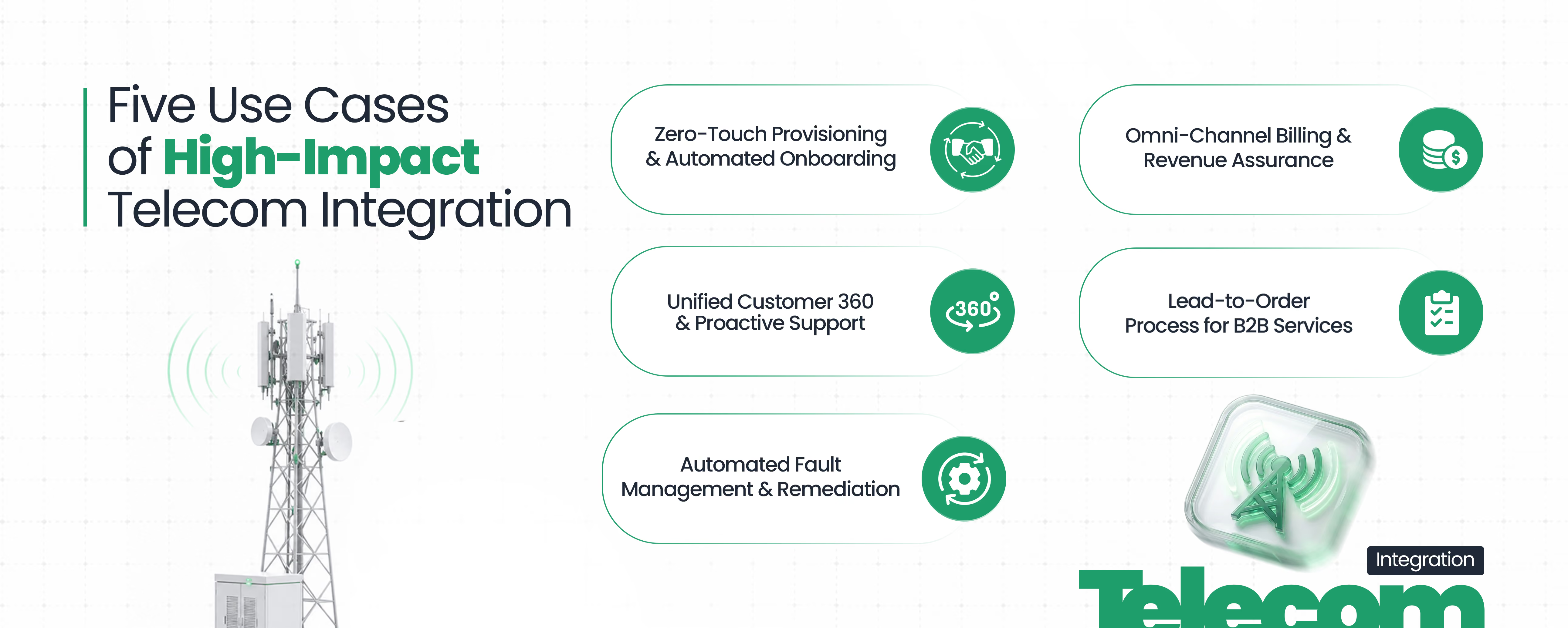
Now that the background has been provided, let's take a look at the five integration workflows that will have the greatest quantifiable influence on telecoms, along with an explanation of each one's actual operation.
The workflow here connects your sales portal directly to the network activation layer. So, the moment a contract is confirmed, the provisioning sequence fires automatically with no manual steps required.
Before automation, this process required multiple handoffs between the network, operations, and sales teams, each of which was a possible source of failure.
A leading North American telecom operator implemented zero-touch provisioning and cut provisioning and activation times by 70%, according to Infosys BPM.
The customer experience impact is immediate. Faster activation means fewer post-sale support calls, fewer second thoughts, and a first impression that builds confidence rather than eroding it.
Support teams working from outdated information will always be reactive. Syncing real-time network performance data into your customer support dashboard changes that dynamic entirely.
Agents can see a customer's current service status, active network issues in their area, and recent interaction history, all in one view, before a call even starts.
This is where telecom CRM automation becomes a retention tool rather than just an operational one. Agents can identify and reach out to customers experiencing degraded service before those customers become frustrated enough to leave.
Given that poor support is the stated reason 39% of telecom customers switch providers, proactive outreach built on integrated data is one of the highest-return investments a telco can make in long-term retention.
Network faults have a time dimension that's easy to underestimate until you're managing one in real time.
An industry survey found that IT downtime costs businesses approximately $33,333 per minute, and for telcos operating under contracted SLAs, every minute past your uptime threshold also carries financial penalty exposure.
Automating telecom workflow management for fault remediation means the moment a network node reports an error, a predefined response sequence begins. Depending on fault severity, the sequence moves through three stages:
The manual triage step disappears, and what remains is a faster path from detection to resolution where SLA compliance doesn't depend on who happens to be at their desk at the time.
{CTA button:Try It For Free:https://www.codeblox.com/sign-up}
When payment gateways and core billing systems operate separately, reconciliation runs in batches, and errors surface late.
A wrong charge sitting unresolved for two weeks becomes a support escalation. Enough of those, and you're looking at churn that could have been avoided entirely.
Integrating your payment gateway with your billing engine to automate telecom workflows around revenue reconciliation means every transaction reflects in real time across all channels.
The operational gains are concrete:
Telecom automation solutions for billing also reduce the internal reconciliation overhead that larger operators currently staff for, which adds up considerably at scale.
Enterprise telecom sales involve custom SLAs, bundled configurations, and technical requirements that touch multiple systems.
When your CPQ (Configure, Price, Quote) tool isn't connected to live network inventory, your sales team quotes from data that's already outdated, sometimes promising capacity or timelines that can't actually be delivered.
Connecting CPQ directly to network inventory through telecom API integration closes that gap across the full deal lifecycle:
This is where most telecom transformation projects stall, and it's precisely the gap CodeBlox was designed to close.
This approach also accelerates telecom digital transformation by reducing dependency on long development cycles.
Traditional custom development for telecom API integration is expensive, slow, and fragile. A single integration between your CRM and provisioning system can take months to build, and it requires ongoing maintenance every time either system updates.
For an industry moving at the pace telecom is today, that development timeline isn't just inconvenient. It's a structural drag on how fast your business can respond to what the market needs.
The no-code integration platform approach makes telecom system integration accessible to your operations teams directly, putting the build capability in the hands of the people who actually understand the business process.
With visual workflow builders, the people who actually understand the business process can design, test, and deploy automations without writing a line of code. What this looks like in practice:
The scalability point is worth underlining here. As your telco adds new service lines, integrates new vendors, or moves into new markets, a no-code foundation lets you adapt without accumulating technical debt.
You're building on something designed to change, not something that needs to be rebuilt every time the business does.
Telecom system integration is the foundation for building scalable, efficient, and future-ready telecom operations.
The integrations covered in this blog aren't advanced projects reserved for operators who have everything else sorted.
They are the operational baseline for any telecom business trying to compete in a 5G market where speed and experience are what customers actually weigh when deciding whether to stay.
This is also where telecom CRM automation plays a critical role in connecting customer data with real-time operations.
Integration is how your business decides how fast it can move, how well it can support customers, and how cleanly it can scale without adding headcount at every stage, and is no longer a purely technical requirement.
The telcos building these workflows now are the ones that won't be playing catch-up in two years, because the operational gap between integrated and disconnected businesses only grows wider over time.
The fastest telcos to automate their workflows will be the ones that define the 5G era, not because automation is a trend worth following, but because the operations it enables are genuinely faster, leaner, and more durable than what came before.
{CTA button:Book a Demo:https://www.codeblox.com/schedule-demo:Ready to eliminate your legacy bottlenecks? See the power of no-code integration in action.}
Find answers to the most common questions about our no-code platform and how it can help you build powerful business application solutions without writing a single line of code.
APIs act as the standardized communication bridge that allows modern cloud applications to talk to legacy on-premises infrastructure seamlessly. In the telecom sector, APIs enable real-time data exchange and trigger-based workflows, allowing disparate software stacks to function as a cohesive digital ecosystem that supports rapid service deployment and automated network management across the entire organization.
Yes, by deploying telecom automation solutions, companies drastically reduce order fallout and the need for expensive manual data reconciliation. Automated workflows minimize administrative overhead and human error in billing and provisioning, allowing telecommunication providers to scale their operations and manage thousands of network nodes without a proportional increase in headcount or operational expenditure.
OSS/BSS integration is the architectural process of linking operational support systems with business support systems to ensure end-to-end service delivery. This integration ensures that when a business event occurs, such as a customer upgrading their data plan, the network layer automatically adjusts provisioning in real-time to maintain perfect synchronization between the service sold and the service delivered.
Integration improves the customer experience by providing a unified customer 360 view that allows for more personalized interactions. When network performance data, billing history, and support tickets are synchronized, agents can resolve issues proactively and eliminate the need for customers to repeat information, leading to faster service activation and significantly higher Net Promoter Scores.
The most frequent integrations involve connecting CRM platforms with Billing and OSS systems to create a unified ecosystem. Common examples include automated customer onboarding, real-time usage monitoring for revenue assurance, proactive customer support triggers based on network health alerts, and automated lead-to-order processing for complex enterprise B2B connectivity solutions like SD-WAN or private 5G networks.
%20(1).avif)
Tilly leads Operations and Solution Delivery at CodeBlox, partnering with enterprise teams to design scalable business systems before development begins. With hands-on experience across ERP, CRM, finance automation, and industry-specific digital transformation projects, she writes about solution architecture, process optimization, AI-powered workflows, and the practical decisions that determine whether enterprise software succeeds in the real world.