- Solutions
- Pricing
.avif)
AI No Code Platforms are changing how businesses build software. Instead of waiting for developers to configure databases, workflows, interfaces, and integrations one by one, teams can describe what they need in plain language and let AI build the underlying application.
That matters because engineering teams already have competing priorities. Maintaining legacy systems and building revenue-critical products often takes precedence, leaving internal tools and business applications stuck in the backlog.
Traditional no-code tools tried to close that gap, but users still had to manually configure workflows, screens, conditions, and data. AI removes much of that work, making a no-code platform far more accessible to non-technical teams.
The result is a simpler way to build business software. Describe what you need, let the platform handle the technical setup, and turn ideas into working applications without adding another task to IT’s queue.
Early no-code platforms removed the need to write code, but they did not remove the complexity of building software. Instead, they shifted that complexity into configuration. Teams still had to understand the logic behind the application to make everything work properly.
That became particularly difficult when applications moved beyond simple forms and basic workflows:
AI app builders take a different approach. Instead of asking users to manually wire the application, they interpret the business requirement itself. Describe the approval process your finance team follows, for example, and the AI can generate the underlying data structure, interface, and workflow logic.
The difference is simple. Traditional no-code asks you to configure the solution. AI no-code lets you describe the problem and helps build the solution.
AI changes app building by generating the schema, the logic, and the interface directly from a plain-language prompt, instead of asking you to configure each layer by hand.
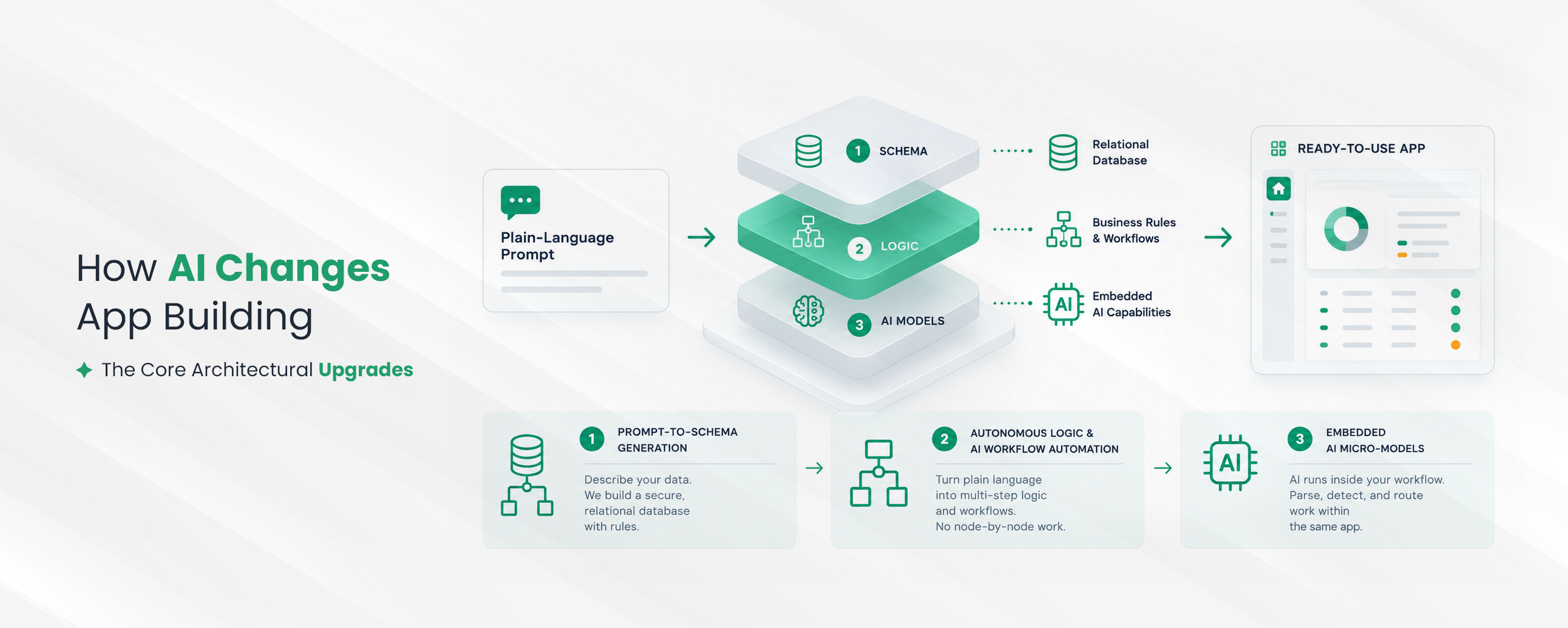
You describe the data you need to track, and the platform builds a production-grade relational database around it, complete with real relationships, foreign keys, and validation rules already in place. That means no manual table dragging on your end.
Multi-step business rules used to take a developer a full sprint to wire. Now a plain-language note turns straight into a working flow, so there is no node-by-node work needed.
This is where AI application development goes beyond chat interfaces. Document parsing, sentiment analysis, and anomaly detection can run directly inside the workflow instead of being bolted on as separate tools.
For example, a contract lands in the inbox, and the platform parses it and routes it to the right approver automatically, inside the same app your team already uses.
Put those three together, and building custom business apps stops looking like assembling a form. Instead, it starts looking like directing a small development team, minus the ticket queue.
That is what separates real no-code app development from a prettier drag-and-drop tool.
The ROI from an AI no-code platform comes from three places: faster deployment, governed citizen development, and lower long-term maintenance costs.
Deployment timelines that used to run into quarters shrink to days once a business team can build directly. This is why CodeBlox customers report cutting IT ticket volume by 80 percent after moving routine app requests off the engineering backlog.
Handing business teams a build tool only works if IT keeps its guardrails, though. Gartner's 2025 CIO and Technology Executive Survey found that 42 percent of organizations have already deployed low-code or no-code platforms, and another 38 percent plan to by 2027.
The same research warns that governance built for professional developers rarely works for citizen developers. That is why a no-code development platform needs built-in role-based access and audit logging from the start. That closes the gap early, instead of creating a new one to fix later.
Business process automation can run across old systems without custom scripts, which means fewer one-off fixes that only the person who wrote them can maintain.
That matters because AI-powered business applications sit on a shared database, so they stay easy to maintain even as the team that built them changes.
No-code workflow automation should keep running long after the person who set it up moves to a new role.
Three use cases show where this approach becomes genuinely useful in an enterprise.
Businesses rarely run on one system. A warehouse has its own software, customer service has another, and finance may use something completely different.
A no-code automation platform can connect these systems and keep work moving between them. For example, when a shipment is delayed, it can automatically create a task for the customer service team instead of someone spotting the problem and forwarding an email.
Invoices, contracts, and receipts still take up a surprising amount of manual time. AI can read these documents, extract the information that matters, and turn it into database records.
It can also flag missing or mismatched information, so teams only need to step in when something needs their attention.
Different users need different information. A sales partner may need access to orders, while an internal auditor needs access to records and reports.
Instead of creating separate applications for each group, a business app builder can adapt the experience based on each user’s role while keeping the underlying data secure.
Once you set up custom workflow automation, you do not have to rebuild the same logic every time a new process comes along. The same foundation can support additional business process automation use cases as the business grows.
That is the real advantage is that you build the foundation once, then keep building on it instead of starting from scratch every time.
CodeBlox pairs a real relational data foundation with an AI powered app builder that handles the logic on top of it.
That combination is what separates a no-code development platform built for enterprise operations from a form builder with a chatbot attached.
Every workspace runs on Azure and ships with single sign-on, encryption in transit and at rest, role-based access, field-level permissions, and full audit logs.
CodeBlox builds these in from day one, instead of bolting them on later when a security review finds a gap, which is exactly the governance layer that Gartner's research says most citizen development rollouts still lack.
CodeBlox also covers the full lifecycle.
One platform handles database design, interface creation, deployment, and live analytics, instead of handing you off to a different tool at each stage.
{CTA button:Start a free 15-day trial:https://www.codeblox.com/sign-up:If your team is still stitching together a builder, a database, and a reporting tool on their own, CodeBlox replaces all three with one governed system.}
An AI no-code platform is not the right tool for everything, and it is worth saying so plainly.
Extreme-scale systems with strict latency requirements, deeply custom algorithms, or workloads that need a fully bespoke data architecture still call for traditional engineering.
The honest framing is to use an AI no-code platform for the operational software that makes up most of an IT backlog, and reserve custom code for the small slice of systems where it is genuinely differentiated. Getting that boundary right early is what keeps a rollout from painting itself into a corner later.
Enterprise low-code platforms are quickly becoming core infrastructure rather than a side tool.
Gartner projects that by 2028, 60 percent of software development organizations will use an enterprise low-code platform as their main internal developer platform. And that would be up from just 10 percent in 2024.
A 90-day phased rollout beats an all-at-once mandate because it gives IT time to build governance guardrails before the platform reaches every department.
Pick one team and one workflow, with a clear owner and a real pain point, not the most complicated process in the building. A small, visible win builds the case for what comes next.
Put access rules, audit logging, and approval guardrails in place before opening the platform to a second team, since guardrails are easier to set once than to retrofit later.
Review what the first team actually built and how they used it. Decide which departments go next, and which processes are better left where they are.
AI no-code platforms replace a manual build process with prompt-driven building, governed access, and AI embedded directly inside the workflow.
That combination, not any single feature, is what makes them the foundation for how business software gets built going forward.
The future of app development belongs to teams that treat software building as something operations does on a Tuesday, not a specialized function they wait months for.
AI no-code platforms make that shift possible, because nobody has to learn to code, and IT does not have to give up control of what gets built.
{CTA button:Start a free 15-day trial:https://www.codeblox.com/sign-up:Turn your operational requirements into production-ready software on CodeBlox today.}
Find answers to the most common questions about our no-code platform and how it can help you build powerful business application solutions without writing a single line of code.
An AI app builder is a no-code tool that reads plain-language requirements. It assembles the database, workflow logic, and user interface for you, instead of asking you to configure every screen and rule by hand.
You describe the app you need in plain language. The platform turns that description into a working data structure, logic, and interface. You never drag a node or write a line of code.
AI no-code platforms let you build business apps by describing what you need in plain language. The platform builds the database, workflows, and interface, so you can create custom software without writing code.
A No Code Development Platform is a complete suite that provides interface builders, backend databases, hosting infrastructure, and security controls for building apps visually.
Yes. A modern Business App Builder lets organizations create tailored applications, such as custom CRMs, internal operations portals, and inventory systems, that match their unique workflows.
%20(1).avif)
Tilly leads Operations and Solution Delivery at CodeBlox, partnering with enterprise teams to design scalable business systems before development begins. With hands-on experience across ERP, CRM, finance automation, and industry-specific digital transformation projects, she writes about solution architecture, process optimization, AI-powered workflows, and the practical decisions that determine whether enterprise software succeeds in the real world.
.avif)
%20(1).avif)

%20(1).avif)

.avif)
.avif)
.avif)
.avif)

.avif)
.avif)
.avif)


.png)
.png)
.png)
.png)
.png)
.avif)
.avif)
.avif)
.avif)
.avif)
.avif)
.avif)
.avif)
%20(1).avif)

.avif)




.avif)
.avif)
.avif)
.avif)
.avif)

.avif)
.avif)
.avif)
%20(1).avif)
.avif)