- Solutions
- Pricing
Let us start this blog by asking a really tough question.
What is the exact time your HR team spends on hiring the best talent? And how much of that time goes into managing other 'intricate' things surrounding that process?
It must be very uncomfortable to face the truth that most hiring pipelines are messy because they are scattered across multiple tools. And it won’t be surprising if the approvals are found stuck in someone's inbox, and candidate updates depend on whoever on your team remembers to follow up.
Whatever mess you see here is not because your HR team is bad at their jobs. The key problem here is the software that this team may or may not be using. A hefty majority of the HR software available to use off-the-shelf is built for a general audience, and forced onto processes that are anything but general!
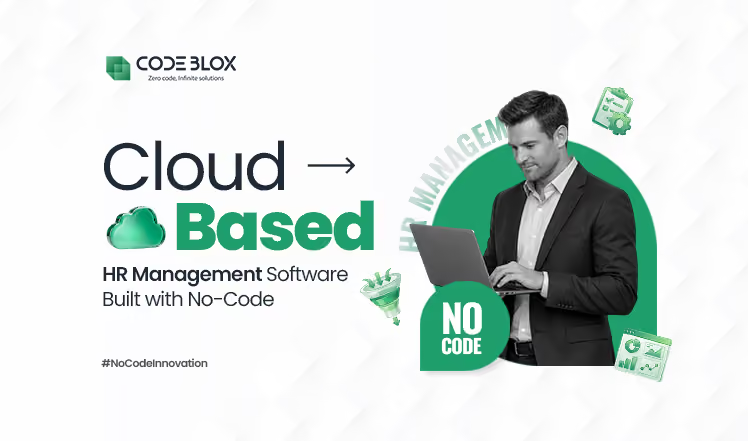
Which is why businesses that have already figured out what the core HR issues are are adopting a no-code HR management system! Why no-code systems? And why are they not adjusting how the team works to fit a platform? Let’s answer these questions. But at this point, it is important for you to introduce you to ‘CodeBlox’, which is helping these HR teams sort their workflow and focus on their actual job!
Generic HR platforms are designed to work for as many businesses as possible. That sounds like an advantage until you realise it also means they are optimised for no one in particular.
A recruitment management system with fixed stages works fine when every role follows the same path. But a technical hire, a leadership hire, and a seasonal hire all have different stages, different approvers, as well as different timelines. Following a generic pipelines force your team to work around these differences instead of through them.
Generic HR software gives every company the same forms, the same stages, and the same logic, regardless of their size or how they hire. For example, a startup with 15 employees and a 300-person company gets exactly the same tool. These tools have no room to add a stage to make candidate evaluation easier or simply remove one that adds no value. You get what the vendor decided, and that is the end of it.
Making an enterprise HR software live takes months. You need technical resources for that, and the pricing, it is built for companies twice your size. But the most frustrating part is that by the time everything is configured and ready to use, the hiring priorities it was built around have already been tweaked.
Once the system is live, even small changes mean going back to the vendor or waiting on a developer. Adding an approval stage means you have to start a vendor conversation. And if you want to update a form field, someone has to raise a ticket to get it done. HR teams eventually stop asking for changes because the effort outweighs the fix, and that's how the system stops working as per your requirements.
At the end of it all, the tools are supposed to support the team. When they do not, the team pays for it every single day! The math is that simple!
No-code simply means building a software visually using configurable logic and easy-to-use drag-and-drop tools. More importantly, the software is made without touching a single line of code!
And if you think that means low quality or limited output, that's not true!
The result of no-code development is a more fully functional business application, which only takes days to build! In short, you save time as well as effort in building something unique and something that fits your processes perfectly.
As per a research by Fortune Business Insights, the no-code AI platform market sat at $6.56 billion in 2025 and is on track to hit $75.14 billion by 2034! Research by Gartner further mentions that 70% of all applications will be built on no-code or low-code platforms.
That last point matters for HR. When the people who run the process can also configure the system, everything moves faster. Adjustments that used to require a developer now take only an afternoon.
In a nutshell, a no-code business automation is doing for software what Canva did for design.
Well, most of the no-code tools are built for prototyping or simple form creation. CodeBlox is built differently! It is built for running your actual business operations, and that distinction shows up in how it handles complexity. Let’s dive in for more details.
Firstly, every application that is built on CodeBlox is production-ready. It handles the multi-step and multi-role workflows that HR teams actually deal with!
Everything from recruiting, onboarding, and employee management are all integrated into a single system with a shared database. There are no duplicate records and no chasing data between platforms. Everything your HR staff requires is pulled from the same source.
Forms, workflows, dashboards, and approval chains are all configured by the HR team directly. No ticket queue, no waiting on a developer for small changes, no dependency on vendor support for updates your team should be able to make themselves.
Once the triggers are set, notifications go out, statuses update, and approvals move forward without anyone initiating them. This way, your team doesn't have to keep the process moving, and the HR automation software just handles it.
Access is controlled at the user, form, and field levels. Sensitive candidate and employee data only reaches the people with the right clearance, and that is configured in the platform, not bolted on afterward.
{CTA button:Contact Us:https://www.codeblox.com/contact:Are you still managing the hiring process through scattered tools? Build a recruitment system that actually matches your workflow. Explore CodeBlox No-Code HR Solutions.}
Here is what the build process looks like in practice.
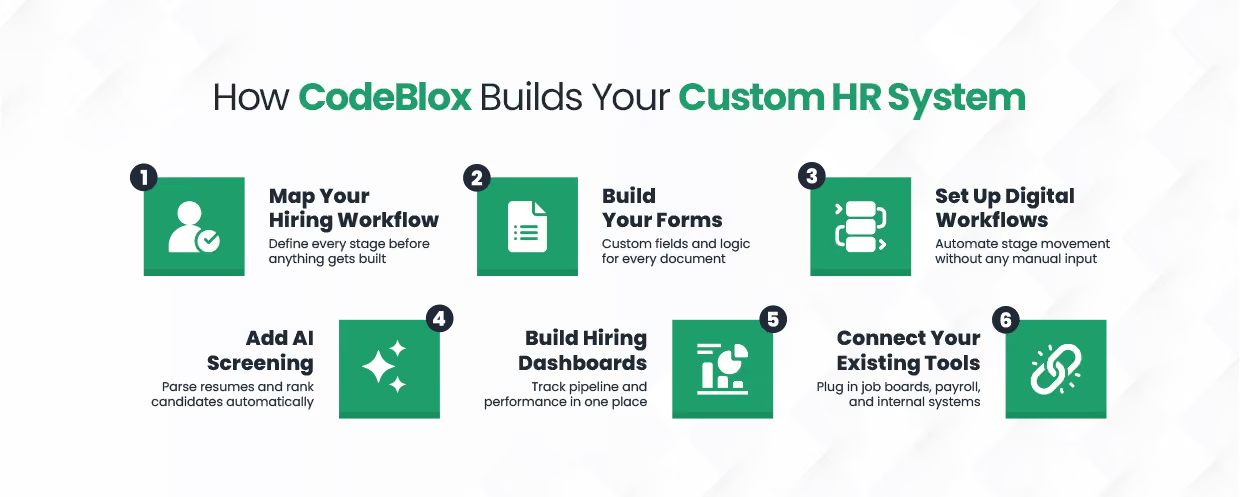
Step 1: Start with your actual hiring workflow
The build starts with how your team hires, and not with finding a template you have to adjust your processes to. Application, screening, assessment, interview, offer, and any role-specific stages your process needs are all mapped out before anything gets built.
Step 2: Build forms that capture the right information
Candidate applications, interview scorecards, and onboarding documents are built to match your requirements. Forms support dynamic fields, conditional logic, and validations, so the right information is always captured in the right format.
Step 3: Set up your Digital Workflows
Trigger-based automation handles the movement between the stages in the digital workflows. New applications get assigned automatically, interview invites go out without manual sending, and candidate status updates go out without anyone touching them.
Step 4: Add AI-assisted screening and communication
Resume parsing, candidate ranking based on defined criteria, and automated communication at each stage reduce the volume of manual work without removing the human judgment that actually matters.
Step 5: Build dashboards for full pipeline visibility
Live pipeline view by role, recruiter performance tracking, and stage conversion rates. Everything hiring managers and HR leadership need, pulled from the same No-Code Databases that power the rest of the system.
Step 6: Connect your existing tools
Job boards, payroll systems, existing HR tools, and internal systems all connect into a single recruitment management system rather than continuing to operate in isolation.
Slow response times are one of the biggest reasons candidates drop off. Automated status updates and notifications keep candidates in the loop without adding anything to the coordinator's plate.
Inconsistent hiring across departments is another one. When each team is running their own version of the process, things fall through. Structured pipelines make sure every role follows the right path, and every stage gets tracked.
For teams still working out of spreadsheets and email threads, the shift to a single system with full audit trails is probably the most immediately felt change.
And for businesses trying to grow hiring volume without growing the chaos that comes with it, the coordination work that used to need an extra pair of hands gets absorbed by the automation.
One more thing worth knowing is that a majority of companies already use applicant tracking tools. Smaller and growing businesses have always wanted the same capability but could never justify an enterprise implementation budget to get there. That is the gap CodeBlox fills.
This is worth being direct about. A no-code HR management system built on CodeBlox makes sense when hiring volume is growing faster than current processes can absorb it, when different roles or departments need different workflows that a single pipeline cannot cover, when the HR team is spending time managing tools rather than managing candidates, or when automation is needed but no developer resource exists to build it.
If two or three of those are already true, the current setup has probably been stretched past its limit.
Akveo's 2025 low-code adoption report shows that 88% of organisations already have a no-code or low-code project underway, and 87% of enterprise developers use these platforms for at least part of their work. HR management and employee portals rank among the top three use cases globally.
No-code business automation is growing because the alternative, waiting on developers for every change, does not work at the pace modern HR teams need to move. A no-code HR management system built on CodeBlox does not lock you into a fixed product. It gives your team a system that evolves as the business does, without requiring outside help to keep it current.
Hiring is a growth function, and a system that slows it down eventually slows the business down with it. Moving from fragmented, manual processes to a no-code HR management system built around how your team actually hires is not as complex as it looks from the outside. With the right platform, it is something HR teams can own and manage themselves.
{CTA button:Book a Demo:https://www.codeblox.com/schedule-demo:Ready to build HR software that works the way your team actually hires? Book a Demo with CodeBlox}
Find answers to the most common questions about our no-code platform and how it can help you build powerful business application solutions without writing a single line of code.
%20(1).avif)
Chris has spent more than a decade designing and delivering enterprise software for organizations with complex operational requirements. Drawing from real implementation experience, he writes about enterprise architecture, CRM strategy, digital transformation, software modernization, and the challenges organizations face when scaling business operations.
.avif)
%20(1).avif)

%20(1).avif)

.avif)
.avif)
.avif)
.avif)

.avif)
.avif)
.avif)


.avif)
.avif)
.avif)
.avif)
.avif)
.avif)
.avif)
.avif)
.avif)
%20(1).avif)

.avif)


.avif)
.avif)
.avif)
.avif)
.avif)

.avif)
.avif)
.avif)
%20(1).avif)
.avif)