- Solutions
- Pricing
Manual transaction processing is expensive, and the real cost rarely shows up as a single line in the budget.
It hides inside reconciliation delays, data duplication across systems, and month-end closes that consume accounting teams for ten days straight before a single executive report gets produced.
Financial systems integration addresses this at the architecture level.
When the data connections between your ERP, banking feeds, payroll systems, and reporting dashboards are properly built, the entire reporting cycle changes.
Enterprise finance automation built on that kind of integrated foundation gives finance leadership accurate, real-time cash visibility without the extended manual verification cycle that currently precedes every executive review.
Connecting data layers cuts reconciliation periods from weeks to minutes, but that compression only holds when the underlying finance automation architecture treats data consistency as a hard technical requirement.
Most corporate accounting failures during digital transitions happen not from poor software choices but from poorly mapped data pipelines that no one fully documented before automation went live.
According to Gartner's research, 90% of finance functions globally are projected to deploy at least one AI-enabled technology solution by 2026.
The organizations closing that gap fastest are not the ones buying the most software. They are the ones building proper data infrastructure before configuring any workflow logic on top of it.
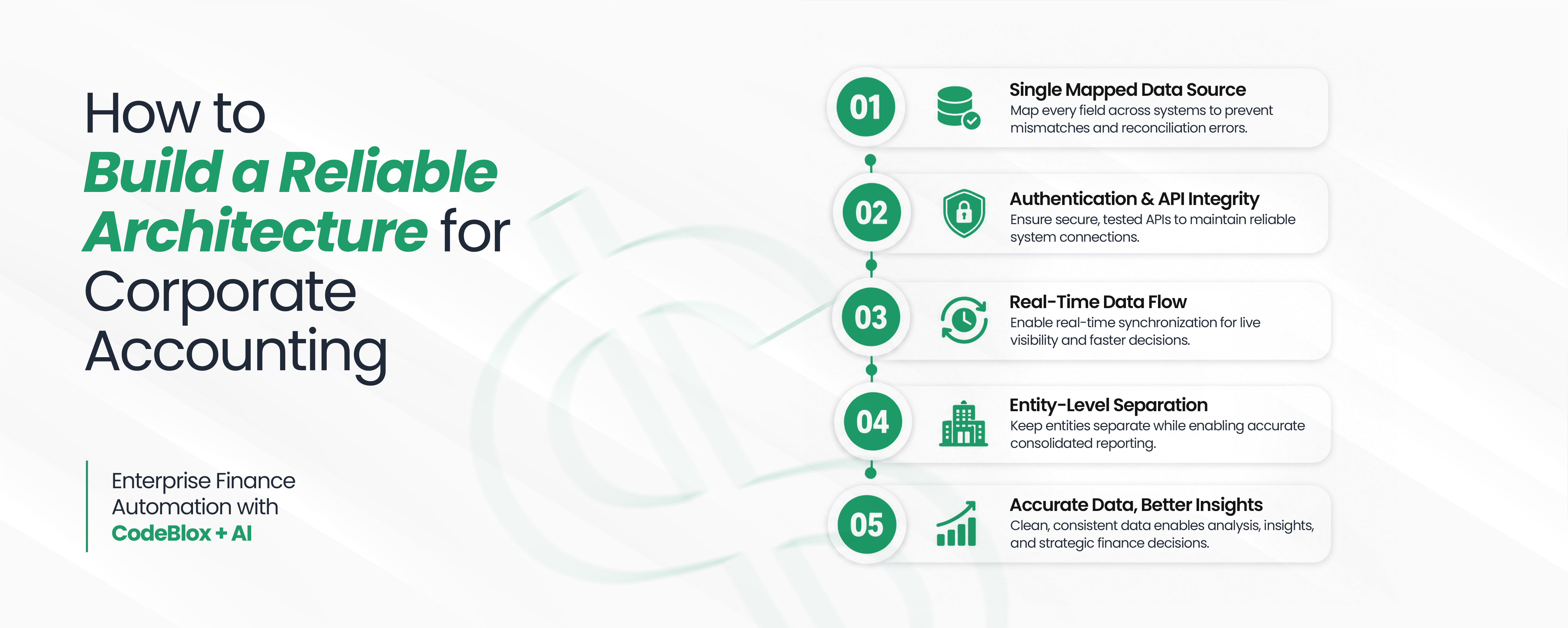
Here is what a reliable finance automation architecture actually requires at the foundational level:
Every ERP output, banking feed, payroll record, and third-party ledger entry needs a documented field mapping before automation goes live.
Without it, field mismatches generate reconciliation errors at the exact point the system was supposed to remove them.
Enterprise finance solutions connecting multiple platforms need secure, tested API protocols at each integration point.
A receivables platform that loses its connection to the general ledger mid-cycle creates more audit exposure than the manual process it replaced.
Intelligent finance systems that run on delayed batch exports cannot give leadership the cash visibility they need for active decision-making.
Real-time data synchronization across all entities is the baseline standard, not a premium add-on.
Companies managing multiple legal entities, currencies, or regional compliance requirements need architecture that keeps data separated at the entity level while still giving the CFO office a consolidated view.
Mixing entity data at the pipeline level creates consolidation errors that take weeks to trace back to source.
When these components are in place, the finance team stops spending its time correcting imported data and starts spending it analyzing outputs.
{CTA button:Book a Discovery Call:https://www.codeblox.com/contact:Ready to map your current integration gaps?}
CodeBlox AI shifts accounting workflows from reactive manual entry into predictive, automated management without requiring a dedicated engineering team to run the platform.
For finance operations teams already managing compliance, reporting, and forecasting across tight monthly deadlines, that independence from IT development queues makes a real operational difference in how quickly the team responds to changes.
The platform connects products, payment gateways, vendor schedules, and multi-entity ledger data into one centralized system that updates continuously in real time.
Here is what makes CodeBlox AI finance automation worth the transition:
The platform connects products, warehouses, stock movement, and vendor schedules into one centralized system that updates continuously in real time.
Rather than manually going through spreadsheets to identify issues, the AI stock management system automatically processes inventory data and highlights what needs immediate attention.
Here is what makes CodeBlox AI worth switching to:
AI in finance automation works by applying pattern recognition to your actual historical transaction behavior, not generic industry rules.
CodeBlox reads invoice approval histories, payment timing patterns, and intercompany flows, flagging inconsistencies before they surface as audit findings.
Every workflow, reorder alert, and approval chain can be configured through a visual point-and-click interface.
Your finance operations manager adjusts reconciliation logic or approval thresholds directly inside CodeBlox. There is no deployment cycle and no ticket queue for what is fundamentally an operational decision.
CodeBlox handles currency conversion rules, intercompany eliminations, and regional compliance parameters within the same interface the team uses for domestic workflows.
Organizations managing multi-currency portfolios do not need a separate configuration environment for each operating region.
The system identifies structural compliance inconsistencies early by building detection logic from your actual data behavior.
Accuracy improves as transaction volume grows, rather than degrading under increasing data complexity the way static rule engines typically do.
Whether the organization is adding a new legal entity, a new payment gateway, or a new currency, CodeBlox accommodates the expansion without rebuilding existing workflow logic from scratch.
With CodeBlox in place, finance teams shift their attention from maintaining inherited manual processes to analyzing the financial outputs those processes produce.
Executing a digital cash strategy protects corporate margins during volatile market periods, but the organizations that manage this transition well share one consistent approach. That is, they introduce automation in structured layers rather than attempting a full system replacement while active fiscal cycles are running.
Finance automation for enterprises performs best when it starts with the workflows generating the most manual correction volume and expands outward from there.
No-code finance automation platforms support phased rollouts because workflow changes do not require code deployment.
The accounts payable team can begin automated invoice matching while the treasury continues its existing bank reconciliation process.
Both groups operate on the same platform without conflicting with each other's data flows or compliance documentation requirements.
Low-code finance platforms give organizations the ability to connect legacy integrations into the CodeBlox framework without a full rebuild.
Proprietary banking API connections, custom ERP field mappings, and internally built reporting pipelines map into the platform without disrupting infrastructure that already functions reliably in production.
Month-end closes that previously demanded ten-day coordination efforts across multiple departments complete in under forty-eight hours on a properly configured platform.
Audit preparation that consumed junior accountant capacity for weeks becomes a structured data export. The finance team's capacity shifts from maintaining processes to analyzing outcomes.
Rather than running compliance checks as a separate audit step, finance automation for enterprises embeds compliance verification into each workflow stage.
Approval chains, documentation requirements, and exception handling all operate within the same automated logic that manages the transaction itself.
When the architecture, the tooling, and the rollout sequence are aligned, the long-term value is not theoretical. The finance function gains reporting speed, forecasting accuracy, and audit readiness that manual coordination simply cannot replicate at equivalent cost.
Fragmented financial operations are not a technology limitation; they are a configuration problem that most enterprises can solve without replacing their entire tech stack.
The integration architecture, automation logic, and compliance controls already exist within platforms like CodeBlox.
What separates finance teams closing their books in two days from those still running ten-day manual reconciliation cycles is not budget or headcount. It is the decision to connect the data layers that are already there.
Organizations that make that connection gain reporting speed, audit readiness, and forecasting accuracy that manual coordination cannot match at comparable cost.
If your finance team is spending more working hours correcting data than using it to drive decisions, the architecture conversation needs to start this week.
{CTA button:Book a Free Demo:https://www.codeblox.com/schedule-demo}
Find answers to the most common questions about our no-code platform and how it can help you build powerful business application solutions without writing a single line of code.
%20(1).avif)
Tilly leads Operations and Solution Delivery at CodeBlox, partnering with enterprise teams to design scalable business systems before development begins. With hands-on experience across ERP, CRM, finance automation, and industry-specific digital transformation projects, she writes about solution architecture, process optimization, AI-powered workflows, and the practical decisions that determine whether enterprise software succeeds in the real world.
.avif)
%20(1).avif)

%20(1).avif)

.avif)
.avif)
.avif)

.avif)

.avif)
.avif)
.avif)


.avif)
.avif)
.avif)
.avif)
.avif)
.avif)
.avif)
.avif)
.avif)
%20(1).avif)

.avif)





.avif)
.avif)
.avif)
.avif)
.avif)

.avif)
.avif)
.avif)

%20(1).avif)
.avif)