- Solutions
- Pricing
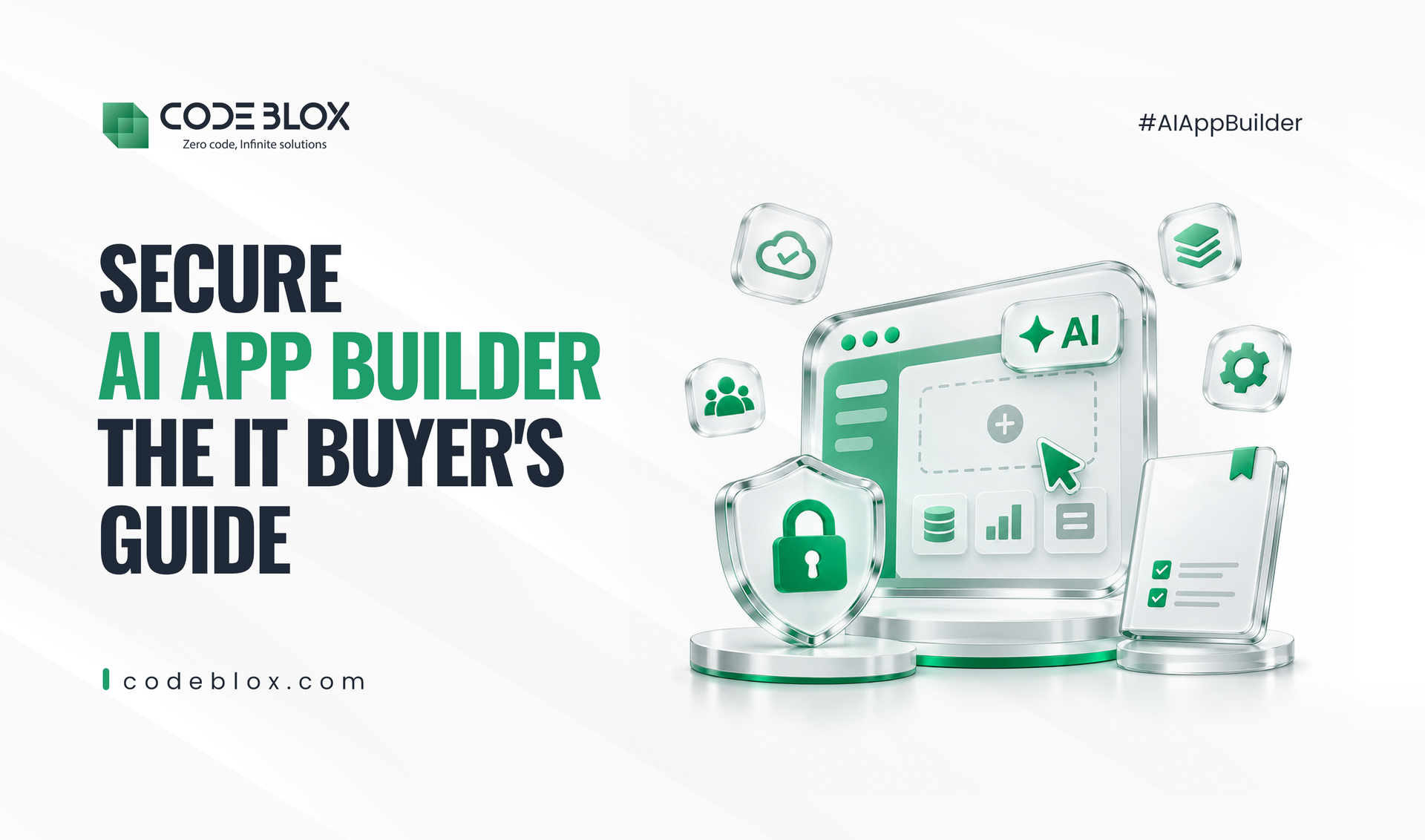
When a business team wants to build its own apps, IT gets a familiar request: approve this tool. With AI app builders, that approval is harder than it used to be, because the tool does not just hold your data; it reads it, processes it, and sometimes sends it to a model. Choosing a secure AI app builder means looking past the demo and asking what happens to your data once it is inside.
This guide is written for the person who has to sign off. It lays out what a secure AI app builder should offer, the questions to ask any vendor, and the red flags that should slow a purchase down. It is a framework, not a sales pitch, so you can hold every platform to the same standard.
The short version: judge a secure AI app builder on four layers, which are access control, data privacy, AI governance, and enterprise controls. Get clear answers on each, verify the claims against the vendor's own documentation, and you can approve with confidence instead of hoping for the best.
Traditional app platforms held your data and ran your logic. AI app builders add a new element: a model that reads business data to generate apps, answer questions, or power features. That extra step changes the risk picture, which is why enterprise AI security now sits at the front of any evaluation rather than the end.
The core worry is simple to state. When someone describes an app, and the platform builds it, business data often flows through an AI model. An IT buyer has to know where that data goes, who can see it, how long it is kept, and whether it ever becomes training material for a model other customers share. These are AI data privacy questions, and a vendor that cannot answer them clearly is a vendor to be cautious about.
The second worry is access. AI app builders put building power in the hands of non-developers, which is the point, but it also means more people touching more data. Without strong access control, a single over-permissioned account can reach far more than it should. AI application security is as much about who can do what as it is about the technology underneath.
None of this means AI app builders are unsafe. It means they deserve a real evaluation, the same secure application development scrutiny you would apply to any tool that touches business data. The rest of this guide gives you that structure.
If you only have a few minutes with a vendor, these are the things to confirm. Each one maps to a layer covered in detail below.
Treat any gap as a question, not an automatic disqualifier. The point is to compare platforms on the same criteria rather than on the strength of a demo.
It helps to picture security as four layers that sit on top of each other. Each one depends on the one below it, so a weakness low down undermines everything above. A useful evaluation works through all four rather than stopping at the feature that demos best.
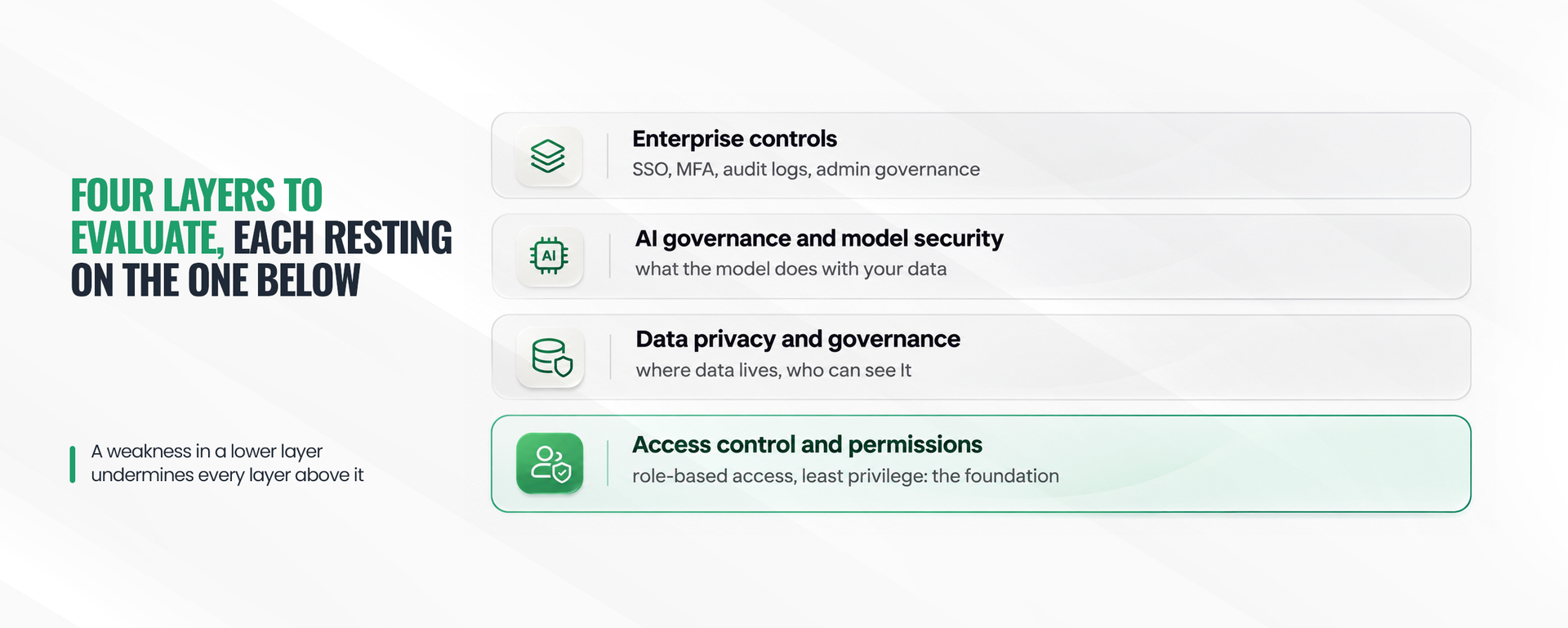
Access control sits at the base because every layer above it assumes the right people are the only ones who can reach your data.
Access control is the foundation because every other protection assumes the right people, and only the right people, can reach your data and your apps. When business users build their own tools, the number of people with access goes up, so this layer matters more, not less.
The standard to look for is role-based access control, often shortened to RBAC. With RBAC, permissions attach to a role rather than to each person, so a finance clerk, a manager, and an admin each see only what their role allows. It keeps access consistent as people join, move teams, or leave.
When you evaluate this layer, check for:
For CodeBlox specifically, user permissions and security cover how roles and access are set, which is the page to review during an evaluation. Whatever platform you assess, strong AI access control here is the single best predictor of whether the rest of the stack can be trusted.
Once you trust who can get in, the next question is what happens to the data they work with. This is where enterprise data security and AI data privacy meet, and it is the layer buyers most often skip until it is too late.
The questions here are concrete, and a good vendor answers them plainly:
Data governance ties these together. A proper data governance platform lets you classify data, set rules for how it is handled, and prove those rules are followed. For regulated industries, that proof is often the difference between an approved tool and a blocked one.
CodeBlox's approach to these questions is set out in AI app data privacy, which is worth reading alongside any vendor's answers. The guiding rule for every platform is the same: you should be able to say where your data is, who can touch it, and how to get it back, without having to guess.
{CTA button:Book a demo:https://www.codeblox.com/schedule-demo:Want to run CodeBlox through your own security checklist? Book a demo and bring your questions.}
This is the layer that did not exist for older app platforms, and it is where AI app builders need the most scrutiny. AI governance is about setting clear rules for how the AI uses your data, and AI model security is about making sure that use cannot be turned against you.
The first question is training. When your business data passes through the model, is it ever used to train a shared model that other customers benefit from? For most enterprises, the only acceptable answers are no, or strictly opt-in. A vendor that trains shared models on customer data by default is a serious concern.
The second is data boundaries. Good AI governance keeps each customer's data isolated, so one company's information can never surface in another's app or output. Ask how that separation is enforced.
The third is control and oversight. Can you see and, where needed, limit what the AI can access? AI risk management means being able to answer, in plain terms, what the model can reach, what it does with it, and what it cannot do. Prompt data, uploaded files, and connected sources all count here.
Strong AI security best practices on this layer look like clear written policy, data isolation between customers, no training on your data without consent, and the ability to review what the AI touched. If a vendor cannot describe these, treat the gap as a real finding rather than a detail.
The top layer is the set of controls that let IT manage the platform at scale and prove it is being managed. These are the features that separate a tool fit for one team from an enterprise AI platform fit for a whole company.
The essentials here are well established:
That last point deserves care. Certifications like SOC 2 or ISO 27001 and compliance with GDPR or HIPAA should never be taken from a marketing page. Ask for the current report or certificate, check the date, and confirm the scope covers the product you are buying. A responsible vendor will share this through a trust center or under an NDA.
For teams that need to see these controls mapped out, CodeBlox's enterprise AI security controls page is the reference to request against. Enterprise application security comes down to management and proof: can IT run the platform centrally, and can it demonstrate that to an auditor?
Use this as a scorecard. Ask every vendor the same questions and record the answers side by side.
A strong vendor answers these without hesitation and backs the answers with documentation. Hesitation, vague answers, or marketing in place of proof are the signals worth paying attention to.
The best way to use this guide is to turn it into a short process. Shortlist a few platforms, send each one the same table of questions, and ask for documentation rather than assurances. Score the answers by layer, weight the layers by what your organization cares about most, and the right choice usually becomes clear.
A few practical notes. Do not treat one missing feature as a deal-breaker on its own; treat it as a question about risk and fit. Do weigh the AI governance layer heavily, because it is the newest and the least standardized across vendors. And always verify compliance claims from the vendor's own trust documentation, with a current date and a scope that matches the product.
CodeBlox is an AI app builder and no-code platform, and the pages linked through this guide, covering user permissions, data privacy, and enterprise security controls, are the right places to run these checks against. If you want the fuller picture of the product itself, the CodeBlox AI app builder overview sets out what it does and who it is built for. As with any vendor, ask for current security documentation directly, rather than relying on a feature list, so your evaluation rests on evidence.
Choosing a secure AI app builder is not about finding a platform that ticks every box in a demo. It is about getting clear, documented answers across all four layers so you can approve a tool your business teams will love without taking on the risk your organization cannot see.
{CTA button:Book a demo:https://www.codeblox.com/schedule-demo:Ready to put a secure AI app builder to the test? Talk to the CodeBlox team and walk through your security checklist together.}
Find answers to the most common questions about our no-code platform and how it can help you build powerful business application solutions without writing a single line of code.
Yes. CodeBlox Enterprise includes unlimited Blox and users, SAML SSO, SCIM, audit log export, custom SLAs, data residency options, and HIPAA-aware infrastructure on Microsoft Azure.
Not fully. AI coding tools return code that someone must maintain. A business application development platform like CodeBlox returns an app with workflows, permissions, reporting, and integrations already built in.
AI software development uses AI to generate code, designs, or configurations from plain-language requests. Traditional development relies on developers writing and testing every part by hand.
Yes. CodeBlox supports custom business applications such as CRM pipelines, HR onboarding, approval systems, inventory tracking, vendor management, and customer portals, all on one shared data layer.
Look for a built-in data layer, workflow automation, approvals, role-based permissions, integrations, audit logs, and security certifications such as SOC 2. Predictable pricing also matters as usage grows.

Chris has spent more than a decade designing and delivering enterprise software for organizations with complex operational requirements. Drawing from real implementation experience, he writes about enterprise architecture, CRM strategy, digital transformation, software modernization, and the challenges organizations face when scaling business operations.