- Solutions
- Pricing
AI can now turn a short prompt into a working business app in minutes. As a result, teams that once waited months for IT can launch an approval tracker or a client portal the same afternoon. In fact, Gartner predicts that 90% of enterprise software engineers will use AI code assistants by 2028, up from less than 14% in early 2024.
However, speed raises a new question. If AI wrote the app, who checks that it works? According to the Stack Overflow 2025 Developer Survey, 66% of developers say their top frustration is AI output that is almost right, but not quite. In other words, AI app development is fast, yet the last mile still needs people.
This guide explains where AI-generated apps usually go wrong and where human review fits best in the testing process.
AI generated app testing is the process of checking an app built by AI for correct logic, safe data handling, and secure access before it goes live. It combines automated checks with human review, because AI can produce code that runs but still misses the business intent.
Traditional testing assumes a developer understood the requirement and wrote code to match it. With AI generated applications, that assumption breaks. The model reads a prompt, fills gaps with guesses, and produces something that looks finished. Testing, therefore, has to confirm that the app works and also that it does what the business actually meant.
In practice, AI software testing covers these areas:
AI-generated apps most often get business context, edge cases, and security wrong. Because the code usually runs and the interface looks clean, these problems stay hidden until real users or real data expose them.
The Veracode 2025 GenAI Code Security Report tested more than 100 large language models on 80 coding tasks. It found that AI introduced vulnerabilities from the OWASP Top 10 in 45% of cases. Moreover, the report noted that security results have not improved even as models got better at writing working code.
Here are the most common gaps:
Consequently, AI code quality depends less on whether the app runs and more on whether it matches how the business really works.
{CTA button:Start building free:https://www.codeblox.com/sign-up:Build your next business app with AI, then review every rule before it goes live.}
Humans should review AI-generated apps wherever judgment, accountability, or risk matters most. That includes business rules, permissions, data privacy, integrations, and the final sign-off before launch.
Human in the loop AI means people stay involved at defined checkpoints instead of trusting the output from start to finish. This matters because trust in AI output is still low, even among developers. The Stack Overflow 2025 Developer Survey found that 46% of developers actively distrust the accuracy of AI tools, while only 33% trust it.
Key human review checkpoints include:
For AI-generated business applications that touch money or people or customers, these checkpoints should be mandatory.
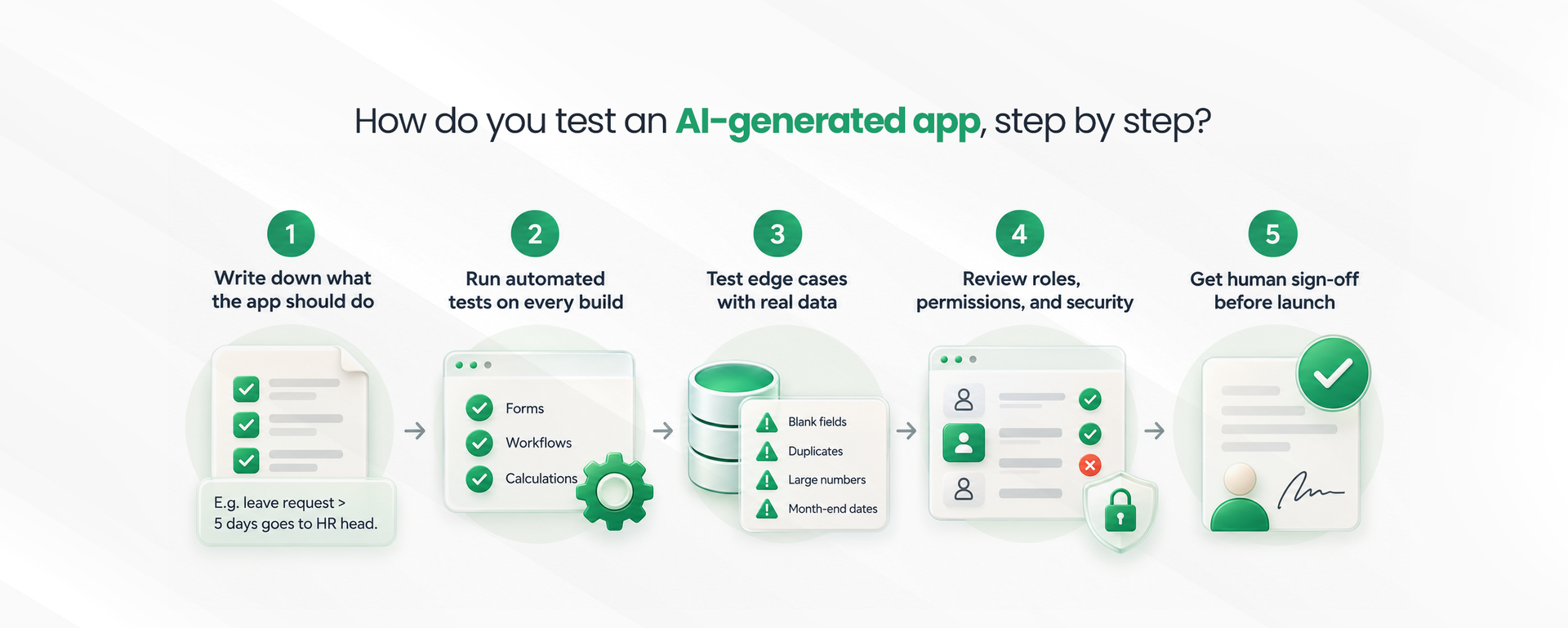
You test an AI-generated app by defining expected behavior first, then running automated checks, then sending the results to human reviewers for sign-off. The five steps below keep that process repeatable.
Before testing starts, list the expected outcomes in plain language. For example, a leave request longer than five days goes to the HR head. This list becomes the test plan, and it also sharpens the original prompt.
Next, use software testing automation to check forms, workflows, and calculations each time the app changes. Automated tests catch regressions quickly, especially when AI regenerates part of the app after a new prompt.
Then, feed the app messy, realistic records. Try blank fields, duplicates, very large numbers, and dates at month end. Since AI rarely plans for these cases, this step tends to surface the most bugs.
After that, log in as each user role and try actions that role should not allow. Teams that test AI-powered workflows should also confirm that nobody can skip an approval or approve their own request.
Finally, a business owner reviews the results, closes open issues, and approves the release. This step makes the process part of responsible AI development, because a real person owns the outcome.
Automated code review cannot fully replace manual review, although it can take over most of the repetitive work. The best results come from using both, each for what it does well.
Automated tools scan code for known vulnerability patterns, style issues, and risky dependencies in seconds. For instance, Veracode recommends software composition analysis to check third-party components in AI-generated code. However, these tools cannot judge whether a workflow matches company policy.
AI code review therefore works best as a first filter:
In short, automation gives coverage, and people give judgment.
You keep AI application security under control by building access rules, input validation, and audit trails into the app from the start, then testing them on every release. Security added after launch usually costs more and leaves gaps.
The risks are specific. According to the Veracode 2025 GenAI Code Security Report, 88% of AI-generated samples were vulnerable to log injection, and Java code failed security checks more than 70% of the time. As a result, security review deserves its own checkpoint.
Practical controls for AI application security include:
Responsible AI development adds one more layer, which is clear ownership. Every AI-built app should have a named person accountable for its rules, data, and access. This is also why platforms built for business process automation tend to include approvals and permissions by default.
You measure AI code quality by tracking how often the app fails, how quickly issues get fixed, and how closely it matches the agreed requirements. A few simple metrics give a clear picture without slowing teams down.
Useful AI code quality metrics include:
Over time, these numbers show whether prompts, reviews, and tests are improving together.
AI has made app development faster than ever, yet faster building also means faster mistakes when nobody checks the output. Research from Veracode and Stack Overflow points to the same pattern: AI writes code that works on the surface but often misses security and intent.
Therefore, the strongest approach pairs automated testing with human review at the moments that matter. An AI app builder such as CodeBlox supports this with built-in approvals, role-based permissions, and audit logs. That way, business teams can build quickly and still keep control of every rule.
{CTA button:Try CodeBlox free:https://www.codeblox.com/sign-up:Turn your next idea into a tested, review-ready business app.}
Find answers to the most common questions about our no-code platform and how it can help you build powerful business application solutions without writing a single line of code.
Businesses can test AI app development projects by writing expected outcomes first, then running automated and edge case tests. A named business owner should then review the results and approve the release.
AI software testing runs automated checks on functions, workflows, and security every time an app changes. Human testers then review business logic, edge cases, and permissions that automated tools cannot fully judge.
AI code review matters because AI often produces code that runs but contains hidden flaws. Veracode's 2025 research found security vulnerabilities in 45% of the AI-generated code samples it tested.
AI generated applications are software apps created from natural-language prompts instead of hand-written code. An AI model builds the screens, data, and workflows, which people then review, adjust, and test.
AI generated app testing checks an app built by AI for correct logic, secure access, and accurate data before launch. It combines automated tests with human review to catch what AI misses.

Chris has spent more than a decade designing and delivering enterprise software for organizations with complex operational requirements. Drawing from real implementation experience, he writes about enterprise architecture, CRM strategy, digital transformation, software modernization, and the challenges organizations face when scaling business operations.