- Solutions
- Pricing


Nobody working a twelve-hour hospital shift is thinking about "digital transformation." They are thinking about the denied claim sitting in their queue and the supply cart that showed up short again. And that’s not all! They also think about the patient history split across three systems that are totally disconnected.
That's the reality most healthcare teams deal with every day, and it's often very different from the conversations happening in boardrooms and industry conferences.
AI in healthcare operations doesn't solve everything. But in a few specific places, it genuinely removes friction that's been building for years. Here's where it actually matters.
AI in healthcare operations steps in wherever people are manually doing work that a system should be handling.
When a biller is cross-checking codes after an eight-hour shift, errors happen. When a supply manager is estimating next week's orders from memory, waste happens. A clinician who opens four tabs to piece together one patient's history loses minutes on every visit. Healthcare AI can pull that record into one view and hand those minutes back.
For many modern providers, AI in hospital management has become a highly practical way to reduce administrative burden, improve team coordination, and support true hospital workflow optimization across every department.
Healthcare organizations are putting AI to work on the operational problems that raise costs, slow down care, and wear on staff. The possible uses are broad, but a handful return measurable results early.
Claim denials are more expensive than most administrators account for. Not just the lost revenue on individual claims, but the staff hours spent reworking, resubmitting, and arguing with payers over errors that were avoidable.
AI in medical billing and coding sits between your team and submission. It checks codes, flags combinations that payers typically reject, and catches small errors, a missing modifier, or a mismatched diagnosis, before anything goes out.
Manual supply chain management runs on gut feeling and recent memory. Both are unreliable, and hospitals pay for it in two ways: over-ordering creates storage rooms full of expired supplies, and under-ordering creates shortages at the worst possible moments.
AI in the healthcare supply chain replaces estimation with pattern recognition. It looks at actual patient volume, usage history, and seasonal trends to tell you what you'll need before you need it.
Here's something that happens in hospitals constantly. A clinician needs to make a quick decision. The relevant history is split across two systems, one of them a scanned document that nobody indexed properly. They spend eight minutes tracking it down.
A few minutes per patient looks trivial on a single chart. Across a full day of visits, it becomes lost hours, and across a week, it becomes lost shifts.
AI in patient data management doesn't mean replacing your existing systems. It means linking the systems a clinic already runs, so the relevant record loads when a clinician opens the chart. The history is on screen before the visit starts, with no hunting across separate tools.
Most hospital software implementations fail not because the technology is bad, but because it was built for someone else's workflow.
A vendor installs something, your staff spends months learning to work around it, and when something needs to change, you're back in the queue waiting on IT. The process that made sense for your team gets replaced by whatever logic a developer hardcoded somewhere.
No-code solutions fix that by putting control where it belongs: with the people who actually understand the operation. Your intake coordinator knows what's broken about intake. Your supply team knows where tracking falls apart. When they can build tools themselves, the solutions actually fit the work.
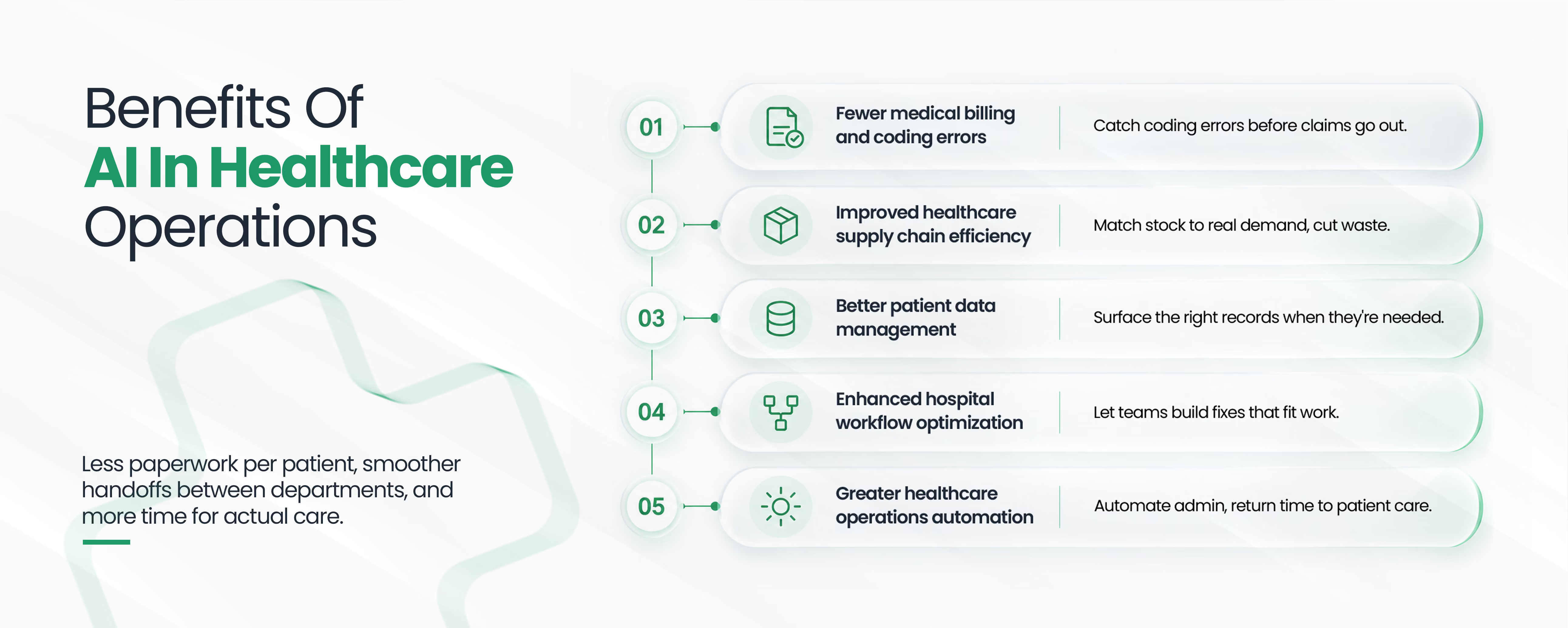
AI in healthcare operations cuts the paperwork that piles up around each patient. It further smooths out the handoff between departments that otherwise would take days.
The result:
It doesn't replace your billers. It simply prevents them from spending valuable time correcting avoidable mistakes.
As a result, hospitals can reduce unnecessary inventory waste, avoid critical shortages, and give procurement teams a more predictable planning process.
Healthcare supply chain teams gain better visibility into demand patterns, helping them make more informed purchasing decisions and reduce unnecessary inventory costs.
AI in patient data management doesn't mean replacing your existing systems. It means connecting what already exists and surfacing the right information at the moment it's actually needed. This reduces unnecessary navigation between systems and helps clinicians access the information they need without disrupting patient care.
No-code healthcare software fixes that by putting control where it belongs: with the people who actually understand the operation. Your intake coordinator knows what's broken about intake. Your supply team knows where tracking falls apart. When they can build tools themselves, the solutions actually fit the work.
This approach supports long-term hospital workflow optimization because teams can continuously improve processes without waiting for lengthy development cycles.
The administrative load in most hospitals isn't high because the people managing it are bad at their jobs. It's high because the systems underneath were never designed to reduce it. Billing errors create rework. Supply gaps create scrambling. Fragmented records create delays.
When those issues are addressed effectively, healthcare professionals can spend more time focusing on patient care instead of administrative workarounds.
As healthcare operations automation matures, hospitals can streamline repetitive administrative tasks while improving visibility across teams and departments.
Many healthcare organizations understand the benefits of AI but struggle to find solutions that fit their existing workflows. This is where a flexible no-code platform can help bridge the gap between operational challenges and practical implementation.
CodeBlox isn't something you hand off to IT and wait on. It's a platform your operations team uses directly.
If patient intake is creating a bottleneck, you build something that targets that specific problem. If supply tracking keeps breaking at the same point, that's where you start. The platform adapts to your workflow rather than dictating a new one.
Your data stays under your control. Your team builds the fix. That's a fundamentally different relationship with software than most hospitals are used to.
Whether you're focused on AI in hospital management, healthcare operations automation, or patient data management, the platform allows teams to solve operational problems without relying on complex development projects.
Successful AI healthcare implementation rarely begins with a large-scale transformation project. The most effective approach is to start with a clearly defined operational problem and build momentum through measurable improvements.
Find the most painful process first. Not the most complex one. The one your staff complains about most. Start there.
Check your data before you automate anything. Automation on bad data doesn't fix problems. It just moves them faster. Clean it up first.
Build one pilot solution. Run it, see what breaks, fix it. Once it works, move to the next thing.
It's slower than a big rollout, but it's also the approach that is most likely to succeed over the long term.
Successful AI healthcare implementation starts with solving one operational problem at a time rather than attempting a large-scale transformation.
Healthcare providers are under increasing pressure to improve efficiency while maintaining high standards of patient care. As a result, many organizations are exploring AI in healthcare as a practical way to streamline operations and reduce administrative complexity.
Healthcare organizations are under constant pressure to do more with the resources they already have. Administrative workloads continue to grow while expectations around patient care, efficiency, and compliance keep increasing.
AI in healthcare operations helps address these challenges by reducing manual work, improving visibility across processes, and supporting better decision-making. Whether the goal is hospital workflow optimization, stronger patient data management, or more efficient healthcare supply chain operations, organizations are increasingly turning to AI in healthcare to eliminate operational friction.
The future of healthcare operations is unlikely to be defined by replacing people with technology. Instead, it will be shaped by systems that remove unnecessary administrative friction and allow healthcare professionals to focus on higher-value work.
The future of healthcare operations will likely be far less reactive than it is today.
The administrative load in most hospitals isn't high because the people managing it are bad at their jobs. It's high because the systems underneath were never designed to reduce it. Billing errors create rework. Supply gaps create scrambling. Fragmented records create delays.
When those issues are addressed effectively, healthcare professionals can spend more time focusing on patient care instead of administrative workarounds.
Rather than being a futuristic vision, this is simply what efficient and well-supported healthcare operations should look like.
{CTA button:Book a Free Demo:https://www.codeblox.com/schedule-demo}
Find answers to the most common questions about our no-code platform and how it can help you build powerful business application solutions without writing a single line of code.
Primarily to catch billing errors before claims go out, forecast supply needs before shortages hit, and surface patient data without making clinicians hunt for it. These are operational challenges where AI can deliver measurable and immediate value.
More connected, less manual, and significantly more efficient. The goal isn't a futuristic hospital. It's one where administrative friction has been reduced enough that clinicians spend most of their time doing clinical work.
Find one process that's actively frustrating your staff and fix that first. Not the most strategic process. The most broken one. Build from a real win rather than a whiteboard plan.
Legacy systems and data quality are the two biggest obstacles. Most hospitals are carrying years of records across platforms that were never meant to connect. Before any AI layer can work properly, someone has to deal with what's underneath it.
When it's scoped correctly, yes. Problems start when AI is positioned as a decision-maker rather than a support tool. Your team still makes the calls. The system gives them better information to work with.
%20(1).avif)
Tilly leads Operations and Solution Delivery at CodeBlox, partnering with enterprise teams to design scalable business systems before development begins. With hands-on experience across ERP, CRM, finance automation, and industry-specific digital transformation projects, she writes about solution architecture, process optimization, AI-powered workflows, and the practical decisions that determine whether enterprise software succeeds in the real world.