- Solutions
- Pricing
Picture a finance team that tracks invoice approvals in a shared spreadsheet. Everyone knows a proper app would save hours every week, but the engineering team is busy with customer-facing work, so the request sits in a queue for months. Retool and CodeBlox were both built to solve this kind of problem, though they go about it in very different ways.
That gap is a big reason these platforms keep growing. Gartner predicted that by 2026, developers outside formal IT departments would make up at least 80% of the user base for low-code development tools. Put simply, more and more internal software is being built by people whose main job isn't software.
This CodeBlox vs Retool comparison walks through how each platform works, who it is really built for, and which one makes more sense for different kinds of teams.
CodeBlox is an AI app builder and no-code platform for business teams.
Instead of starting from a blank screen, a user simply describes what they need, for example, "an approval flow for vendor payments over $5,000."
CodeBlox AI then creates the tables, workflows, permissions, and dashboards behind that app. If something needs to change later, the team can click to edit it or just type another request.
Teams that want a head start can begin with a ready-made solution for CRM, HR, finance, project management, or inventory and adjust it to fit. Beyond app generation, CodeBlox works as a complete business app builder, with a broad set of no-code platform features:
Retool is a development platform for internal software, and the company says more than 10,000 companies use it.
A typical build starts with a developer dragging tables, forms, and buttons onto a canvas. They then connect these elements to a database or API and use JavaScript and SQL to define how everything works.
On top of that, AppGen can draft an app from a prompt, Retool Agents can carry out multi-step AI tasks, and Retool Workflows run scheduled jobs and data processing in the background.
For engineering teams, Retool is a strong internal tool builder, especially when the goal is building internal tools at scale on top of databases they already run. It also supports native mobile apps and a self-hosted version for companies that need to keep data on their own servers.
On paper, both platforms promise faster internal tools.
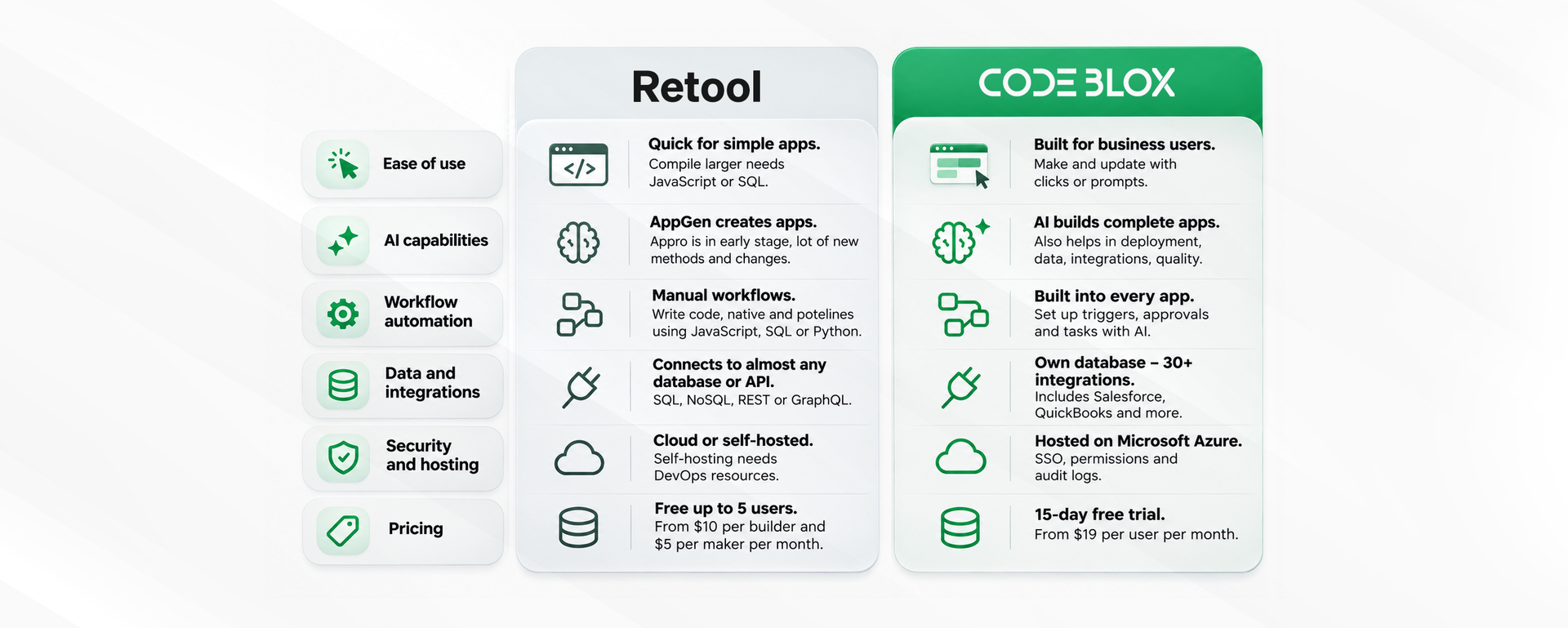
The real differences appear when looking at who does the building, how AI fits in, and what it costs to run apps over time. Here is how they compare across six areas that matter most to business teams.
Ease of use is where the two platforms differ the most.
In Retool, simple tables and forms come together quickly, but anything more involved, such as custom validation or multi-step logic, usually means writing JavaScript or SQL. That is why a developer tends to stay involved long after an app launches.
CodeBlox takes the opposite approach. The person who runs a process usually knows best what the tool should do, so CodeBlox lets that person build and change it. For instance, an HR manager who wants to add a probation review step to onboarding can do it in a few clicks, without raising a ticket. Over time, this speeds up business application development across the whole company, because small fixes no longer wait in an engineering queue.
Both platforms support AI powered app development, but they use it differently.
Retool's AppGen drafts apps from prompts, and its agents can complete multi-step tasks using a company's data and APIs. Since the output often needs reviewing and extending in code, these features are most useful to developers.
CodeBlox applies AI in two places. The first is building, where a prompt becomes a complete app with data, workflows, and dashboards. The second is daily work, where CodeBlox AI drafts replies, categorizes requests, scores records, and answers questions inside the app.
A procurement team, for example, can have every new vendor request scored and sent to the right approver automatically.
Retool Workflows is a developer tool at heart.
Engineers use it to write scheduled jobs, alerts, and data pipelines in JavaScript, SQL, or Python, which gives them plenty of control but leaves business users out of the process.
In CodeBlox, workflow automation software is not a separate product. It comes built into every app, so triggers, schedules, approvals, and rules are set up on screen, and AI workflow automation takes care of routing and scoring.
This means business process automation stays with the team that actually owns the process, and they can adjust it whenever the process changes.
Retool is at its best when data already lives in production databases and internal APIs. It connects to almost any SQL or NoSQL database and REST or GraphQL API, which suits enterprise software development teams that already manage production systems.
CodeBlox comes with its own database, so a team can start building even if its data currently lives in spreadsheets. It also connects to over 200 business tools, such as Salesforce and QuickBooks, and offers a REST API and webhooks for anything custom.
For most custom business applications, such as CRMs, trackers, and portals, that mix covers what teams need.
Retool offers cloud hosting and a self-hosted version, which appeals to companies that must keep everything inside their own infrastructure. Self-hosting, however, needs DevOps resources to run and update.
CodeBlox runs on Microsoft Azure, with single sign-on, encryption, role-based and field-level permissions, and audit logs built in. For IT teams evaluating an enterprise app development platform, that means keeping control over access and data without having to run servers themselves.
Retool splits pricing between builders and internal users.
According to its published rates, the free plan covers up to 5 users, team costs $10 per builder and $5 per internal user per month billed annually, and business costs $50 per builder and $15 per internal user. External users, extra workflow runs, and AI usage can add to the bill.
CodeBlox offers a 15-day free trial with no credit card required, and plans start at $19 per user per month. There is no separate builder tier to plan around, so anyone with access can help build and improve apps.
{CTA button:Start your free CodeBlox trial:https://www.codeblox.com/sign-up:Want to see what your team can build without waiting on developers?}
Retool is usually the right call in these situations:
CodeBlox tends to be the better fit in these situations:
For teams in these situations, CodeBlox is a practical Retool alternative. It supports rapid application development while leaving developers free to focus on the core product.
The CodeBlox vs Retool choice is really a question of who will build and maintain the apps. If developers will own them, Retool offers a powerful, code-first toolkit.
If the goal is to let operations, HR, finance, and sales teams build for themselves, CodeBlox is the stronger option, with an AI app development platform, ready-made solutions, built-in automation, and 200+ integrations.
That makes it a natural home for the business operations software every department depends on.
{CTA button:Get started free :https://www.codeblox.com/sign-up:Turn your next process into a working app with CodeBlox.}
Find answers to the most common questions about our no-code platform and how it can help you build powerful business application solutions without writing a single line of code.
AI powered app development turns a written request into a working app in minutes. Business teams can build and update their own tools faster, without waiting for developers or IT backlogs.
Yes, CodeBlox includes a built-in database with over 40 field types, formulas, and data imports. Teams can build database apps with grids, Kanban, calendars, and other views without code.
Yes, both platforms support workflow automation. Retool Workflows suits developer-built jobs and pipelines, while CodeBlox includes visual triggers, approvals, and AI routing inside every app.
CodeBlox is a no-code development platform. Business users build apps without writing code, while developers can still use its open REST API and webhooks for deeper integrations.
Businesses should look for prompt-based building, workflow automation, integrations, permissions, and clear pricing. The platform should also match the skills of the people who will maintain apps after launch.

Chris has spent more than a decade designing and delivering enterprise software for organizations with complex operational requirements. Drawing from real implementation experience, he writes about enterprise architecture, CRM strategy, digital transformation, software modernization, and the challenges organizations face when scaling business operations.