- Solutions
- Pricing
Retail businesses lose billions every year because of operational mistakes. A product shows as in stock, but the shelf is empty. Staff spend hours fixing spreadsheets instead of helping customers. This is the reality inside many retail businesses today.
The biggest issue is not lack of effort. Most retailers already use multiple software tools. The problem is that these systems rarely work together properly.
That is where most retail inventory management problems begin.
And once all operations stop syncing properly, the entire business slows down.
These are some retail operations management challenges modern retailers face. Small mistakes can become expensive later on.
Retailers are looking toward AI automation and no-code systems that simplify operations instead of adding more complexity.
That is wḣere helps retail businesses fix disconnected operations with AI-driven workflows and scalable automation.
Most retailers today use separate tools for inventory, billing, customer communication, warehouse tracking, and analytics.
This creates serious Retail business operational challenges that affect daily decisions.
A retail manager may think stock is available because the dashboard says so. But the warehouse already ran out hours ago. An operations team may spend entire mornings cleaning spreadsheets instead of managing stores. These problems grow faster when businesses scale.
More stores mean more data. More suppliers. More inventory movement. More customer interactions.
Without strong retail operations management, even growing businesses start slowing themselves down.
Inventory and POS systems are supposed to simplify retail. Instead, many businesses fight with them every day.
Some of the most common retail inventory POS problems include:
Most of these issues happen because systems were added over time without proper integration. Eventually, operations become reactive instead of controlled.
And the cost is higher than most businesses think.
Poor retail inventory management leads to overstocking, dead inventory, and delayed fulfillment.
Even small operational errors create large revenue leaks over time.
Many businesses believe buying expensive software solves operational issues.
Usually it doesn't.
Large enterprise platforms are difficult to customize. Teams struggle to adapt workflows. Staff avoid using complicated systems.
That creates another layer of operational friction.
Traditional retail management software often comes with:
Software that takes months to adjust becomes a problem itself. This is why more retailers are moving toward no-code retail solutions.
They want systems that adapt quickly without heavy development cycles.
{CTA button:Book a Discovery Call:https://www.codeblox.com/contact:Still dealing with disconnected retail systems and manual inventory issues? Connect with CodeBlox and see how AI-powered automation can simplify your retail operations.}
Retail operations generate huge amounts of data every day.
Sales numbers. Inventory movement. Customer behavior. Supplier timelines. Product demand trends.
Most businesses collect this data but never use it properly.
This is where AI in retail operations creates real value. AI helps retailers stop reacting late.
So, instead of discovering inventory problems after they happen, businesses can predict issues before they grow.
This includes:
The goal is not to replace teams.
The goal is to help teams make faster and better decisions.
CodeBlox focuses on solving operational bottlenecks without making businesses depend on complicated development processes.
Its approach combines automation, AI workflows, and flexible integrations that work with existing retail systems.
Instead of forcing businesses to rebuild everything from scratch, CodeBlox connects operations intelligently.
This makes retail inventory management far easier to control. Retailers can centralize inventory visibility across stores, warehouses, and POS systems. They can automate repetitive tasks that normally consume operational time. They can reduce manual data handling and improve operational accuracy.
Most importantly, teams get a single operational view instead of disconnected dashboards everywhere.
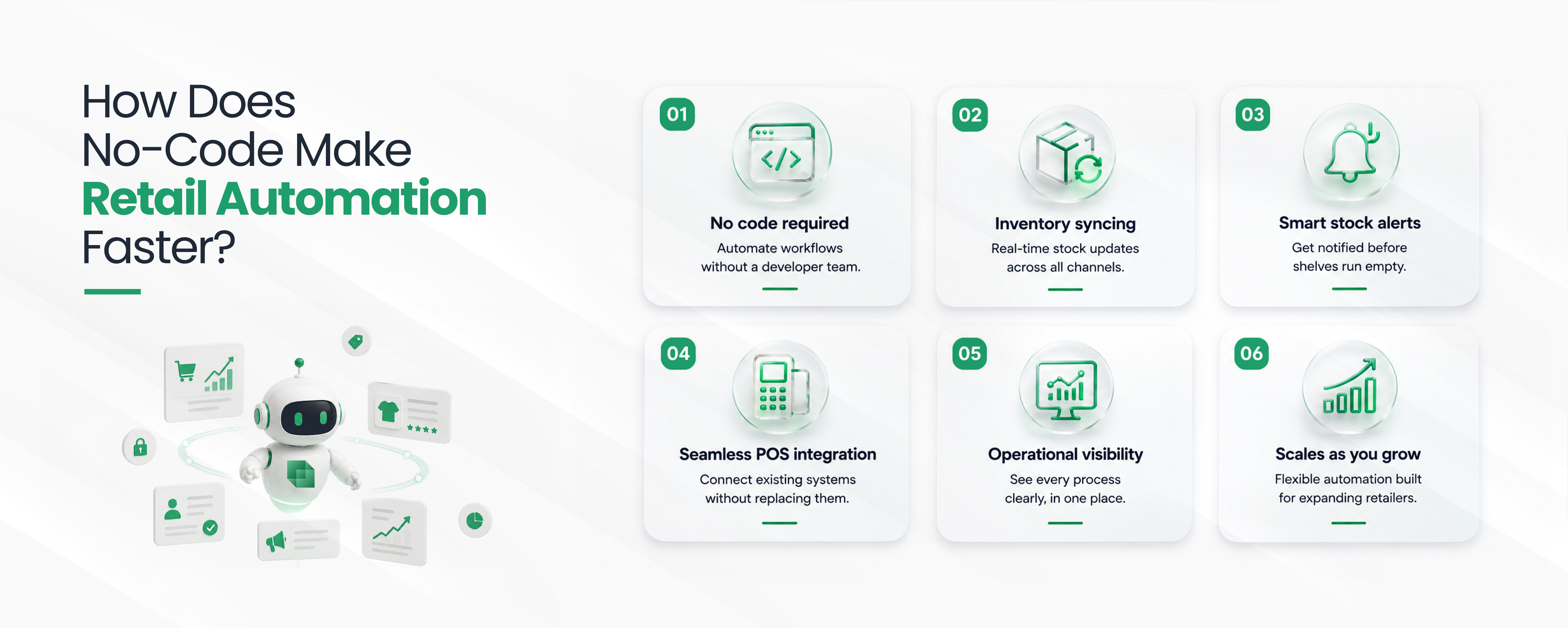
One major advantage of CodeBlox is its focus on no-code retail solutions. Retail businesses often delay automation because development projects feel expensive and slow.
With no-code, businesses can automate workflows without large teams.
Processes like inventory syncing, stock alerts, order updates, and approval flows become easier to manage.
This is especially useful for growing businesses that need operational flexibility.
With no-code POS integration, retailers can connect existing systems without replacing everything they already use.
That reduces downtime and lowers implementation stress.
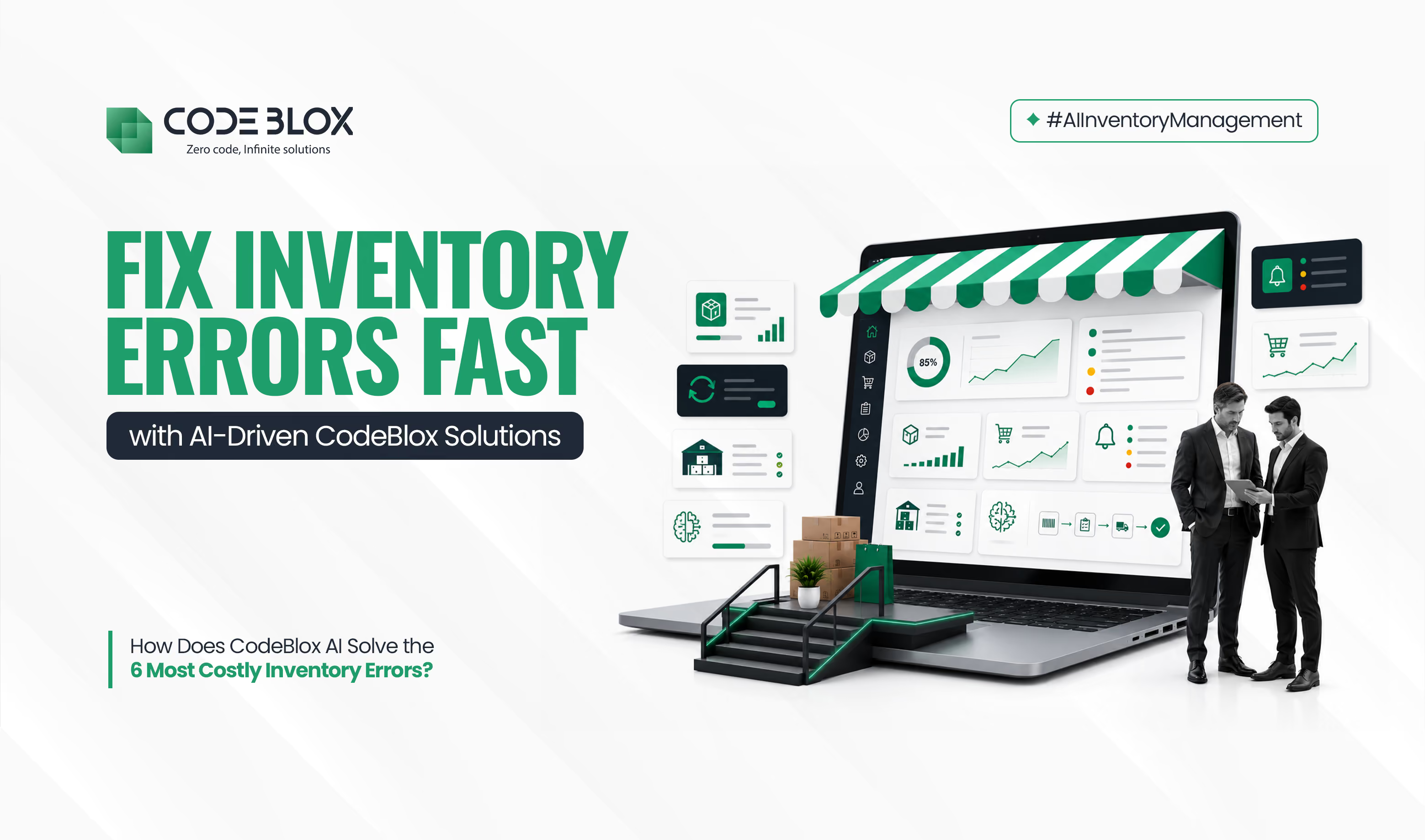
Retailers looking to reduce stock errors and improve operational visibility are increasingly turning toward AI-driven inventory management to make faster inventory decisions.
And learn more about scalable automation systems here: No-Code Solutions
Inventory issues are only part of the problem.
Customer operations have become equally difficult.
Retail customers now expect:
But disconnected systems make this difficult.
A customer may contact support asking about an order status while the support team has no real-time inventory information.
A loyalty program may fail because customer purchase history sits in multiple systems.
A retailer may lose repeat customers simply because operations feel inconsistent.
Strong retail data management becomes critical here.
Retailers need customer data, inventory data, and sales data connected in one operational ecosystem.
Without that connection, businesses operate blindly.
One reason retail teams struggle is a lack of operational visibility. Different departments use different tools. Nobody sees the complete picture.
Good retail operations management requires centralized visibility.
Teams should know:
AI combined with automation helps surface this information faster.
That allows businesses to respond quickly instead of spending hours collecting reports manually.
Many small retailers assume automation is only for enterprise brands. However, that is not true.
Smaller businesses suffer even more from operational inefficiencies. Because small businesses have smaller teams and limited resources.
With limited resources, manual inventory tracking is exhausting. This is why flexible retail management software and automation systems matter even for smaller stores.
With platforms like CodeBlox, businesses can start small and scale gradually.
Businesses that want faster automation without heavy development overhead are now adopting No-Code Solutions to simplify day-to-day retail operations.
Retail competition has changed. Customers move fast. Expectations are higher. Margins are tighter. Operational inefficiencies now directly impact revenue.
Poor retail inventory management causes stockouts. Slow POS systems frustrate customers. Disconnected workflows delay decisions. Bad customer experiences reduce retention. And manual operations increase staff burnout.
Retailers need systems that simplify operations instead of adding more complexity.
That means combining AI, automation, and flexible integrations into one operational workflow.
Most retail businesses are not struggling because they lack effort.
They are struggling because disconnected systems create constant operational friction.
Inventory issues. POS syncing delays. Customer management gaps. Reporting problems. Manual workflows.
These are not isolated problems anymore. They are connected operational failures. Modern retail inventory management needs smarter systems that work together.
That is where CodeBlox helps retailers simplify operations using automation, AI, and scalable no-code workflows.
Instead of adding more software chaos, businesses can build connected operations that actually support growth.
And in retail, operational clarity matters more than ever.
{CTA button:Book a Discovery Call:https://www.codeblox.com/schedule-demo:Want to see how smarter retail automation actually works in real workflows? Schedule a demo with CodeBlox and explore solutions built for modern retail businesses.}
Find answers to the most common questions about our no-code platform and how it can help you build powerful business application solutions without writing a single line of code.
%20(1).avif)
Tilly leads Operations and Solution Delivery at CodeBlox, partnering with enterprise teams to design scalable business systems before development begins. With hands-on experience across ERP, CRM, finance automation, and industry-specific digital transformation projects, she writes about solution architecture, process optimization, AI-powered workflows, and the practical decisions that determine whether enterprise software succeeds in the real world.
.avif)
%20(1).avif)

%20(1).avif)

.avif)
.avif)
.avif)
.avif)

.avif)
.avif)
.avif)


.avif)
.avif)
.avif)
.avif)
.avif)
.avif)
.avif)
.avif)
.avif)
%20(1).avif)

.avif)





.avif)
.avif)
.avif)
.avif)
.avif)

.avif)
.avif)
.avif)
%20(1).avif)
.avif)