- Solutions
- Pricing
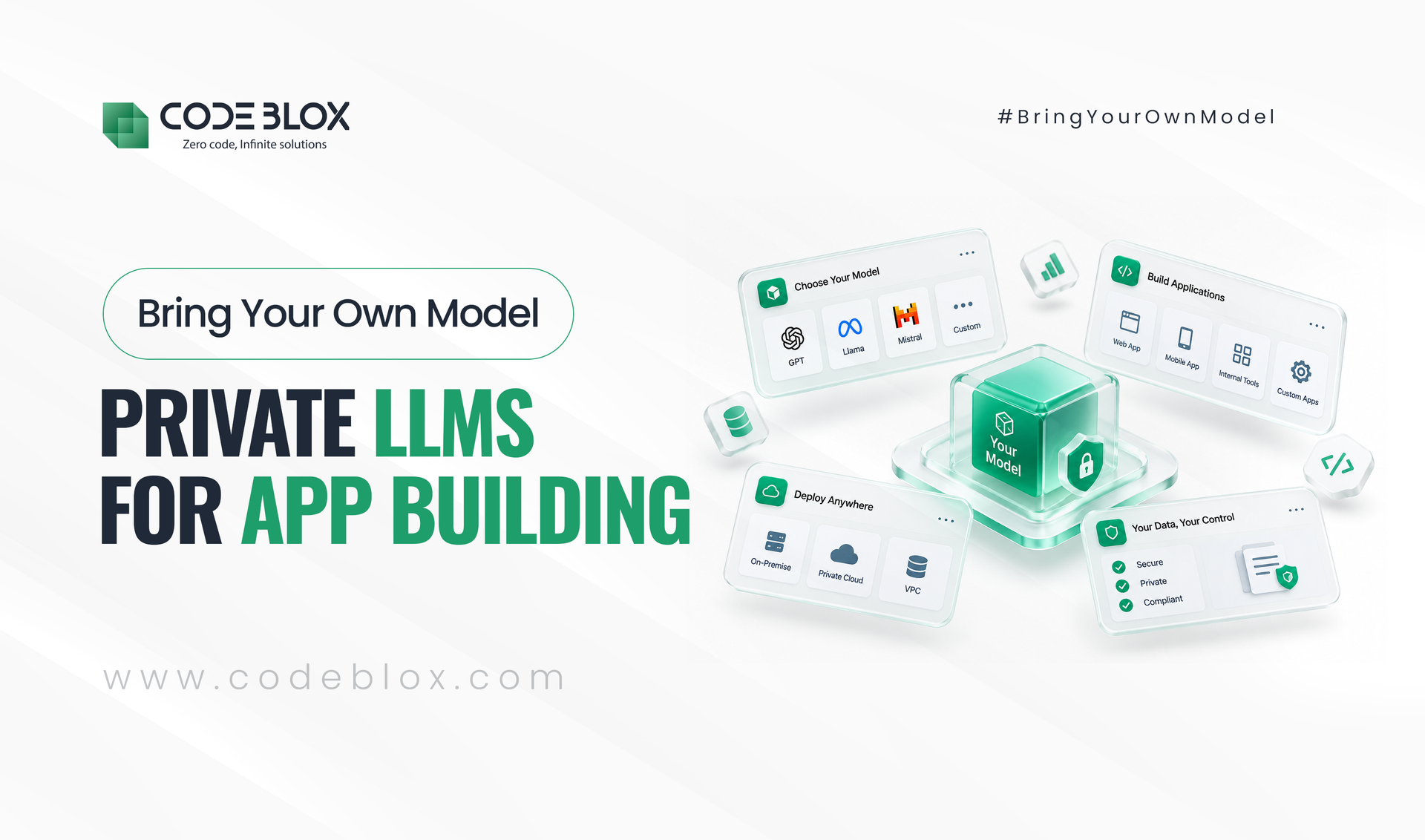
Private LLMs for app building give companies a way to use generative AI inside business apps without sending sensitive data to a shared public model. A private LLM is a large language model that runs in an environment the business controls, such as its own cloud tenant or its own servers. When an app platform supports bring your own model, the team picks that private model, and every AI feature in the app uses it.
This matters most for teams that handle customer, financial, or health data. This blog explains what private AI models are, how LLM app development works with them, which deployment option fits which business, and what to check before choosing a platform.
Three trends explain the growing interest in private AI models. First, general models often fall short on specialized business tasks. Gartner predicts that by 2028, over half of the GenAI models used by enterprises will be domain-specific, meaning trained or tuned on data from one industry or function.
Second, regulation is pushing data closer to home. In the same 2026 trends report, Gartner expects over 75% of enterprises in Europe and the Middle East to move workloads to sovereign or local solutions by 2030, up from less than 5% in 2025.
Third, AI is moving into everyday software. Gartner also expects 40% of enterprise apps to include task-specific AI agents by the end of 2026. As a result, the model behind each app now matters as much as the app itself.
A private LLM is a language model that runs in an environment only one organization uses or controls. It can be a commercial model hosted in a dedicated cloud tenant or an open-weight model, meaning a model whose files are publicly available that the business runs on its own hardware.
In simple terms, "private" describes where the model runs and who controls the data. It says nothing about which company built the model. Three things define it:
AI model deployment for private LLMs usually follows one of three patterns. Each gives a different balance of control, effort, and cost.
In practice, most businesses start with a dedicated cloud tenant, then move specific workloads to a private cloud or an on-premise LLM if sovereignty rules require it.
LLM app development is the process of building software that uses a language model to read, write, or reason over data. In a business app, the model usually does one of two jobs.
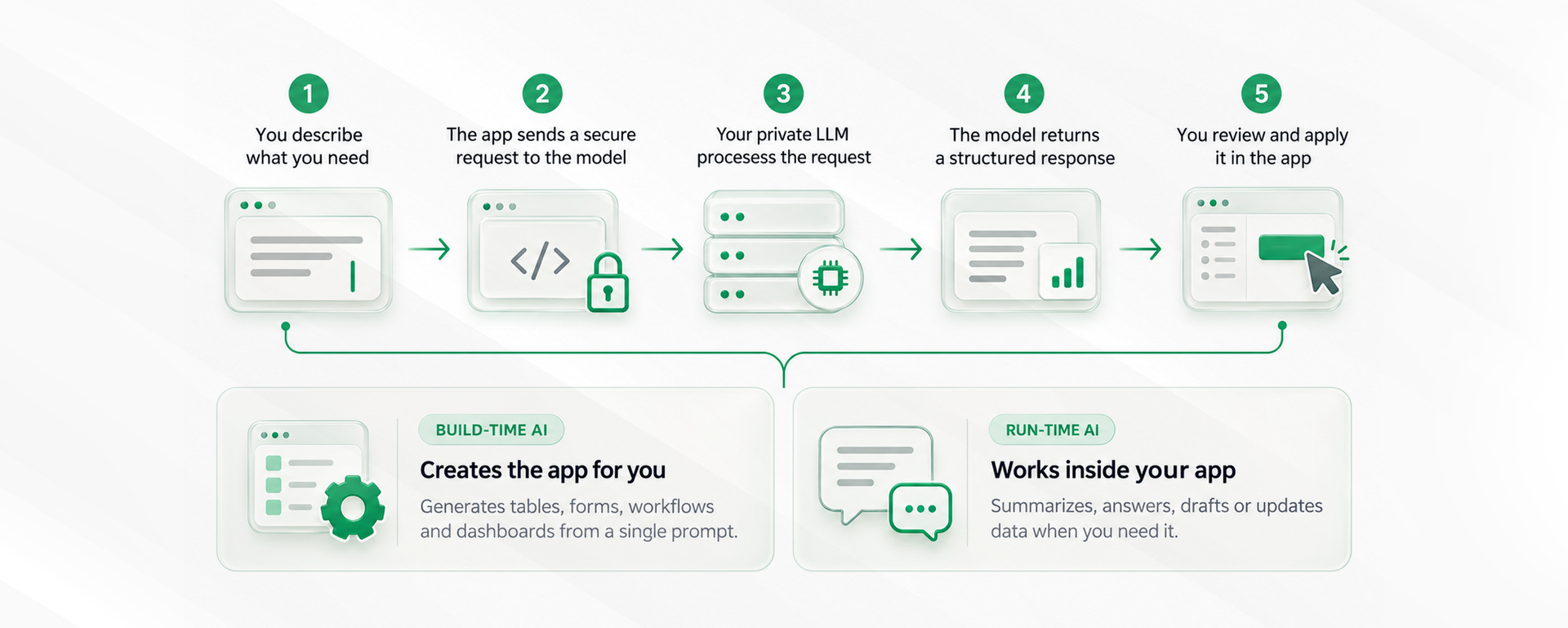
Because both jobs send business data to the model, the model choice affects every app a team builds.
CodeBlox AI covers both jobs. It builds a full app from a single prompt, and inside a finished app it answers data questions or updates fields on command. Each change appears as a proposal first, and every AI action is logged and reversible.
LLM integration is the technical link that makes this work. The app platform connects to the model through a secure API endpoint, sends a structured request, and receives a structured answer. With a private model, that endpoint sits inside the company's own environment. In CodeBlox, AI requests also follow the same role-based and field-level permissions as the rest of the workspace.
{CTA button: Book a Demo:https://www.codeblox.com/schedule-demo:Want AI features in your business apps without sending data to a shared public model? See how private model deployment works on CodeBlox.}
Traditional LLM app development needs developers to write code and maintain integrations. However, an AI no-code platform moves most of that work into a visual builder. Business users describe what they need, and the platform builds generative AI applications around that request, handling the model calls behind the scenes.
The gap in many tools is model choice. Many AI app builders run on a single fixed model and a shared endpoint. That works for prototypes, but it often fails a security review in a bank or a hospital.
An AI application builder designed for business should offer three things together:
On CodeBlox, for example, Enterprise customers can request private model deployment, including Azure OpenAI tenants or self-hosted models for strict data location rules. This bring your own model option to sit alongside the default model, so teams can match each workload to the right level of control.
A private AI platform is any system that lets a business build and run AI features on models it controls. Before choosing one, it helps to ask the same questions a security team will ask.
These questions cover AI data privacy and enterprise AI security in one review, so the platform and the model should be chosen together.
CodeBlox covers these checks by default.
Benefits:
Trade-offs:
For most enterprise AI development, the practical answer is a mix: a default model for low-risk work and a private model for sensitive apps.
The simplest path is to start with one process that handles sensitive data, such as vendor approvals, claims review, or customer support.
With no code app development on CodeBlox, this first app can start from one prompt and go live in weeks rather than months. After that, the same private model can power the next app without a fresh security review.
{CTA button: Talk to Experts:https://www.codeblox.com/schedule-demo:Ready to build AI apps on a model your business controls? Talk to the CodeBlox team about bringing your own model.}
Find answers to the most common questions about our no-code platform and how it can help you build powerful business application solutions without writing a single line of code.
LLM integration is the technical connection between an application and a language model. It sends structured requests to the model and returns structured answers, while the app's permissions control which data is shared.
LLM app development connects a language model to an app through a secure API. The model then helps build the app or works inside it, drafting, sorting, and answering questions using business data.
Private AI models are any AI models, including language, vision, or prediction models, that run in an isolated environment under company control. They support compliance by keeping sensitive data inside approved systems.
A private LLM is a large language model hosted in a dedicated cloud tenant, private cloud, or company data center. Only one organization uses it, and its data never trains shared models.
Private LLMs for app building are language models that power AI features inside business apps while running in an environment the business controls. They keep prompts and records out of shared public models.

Tilly leads Operations and Solution Delivery at CodeBlox, partnering with enterprise teams to design scalable business systems before development begins. With hands-on experience across ERP, CRM, finance automation, and industry-specific digital transformation projects, she writes about solution architecture, process optimization, AI-powered workflows, and the practical decisions that determine whether enterprise software succeeds in the real world.